Five Brands That Have Rebranded to Capture the Zillennial Market

Images courtesy of thenewyorktimes.com, Coach, and Birkenstock, respectively

It’s no secret that 2020 was a tough year for the fashion industry, but there were also some bright spots. A handful of brands have made it through the turbulence and are navigating a rebrand and successfully engaging with “zillennials.” According to Urban Dictionary, “A zillennial is a micro generational overlap of people born ‘three years before the end of millennials and/or three years after the start of Generation Z. So, essentially anyone born between 1992 and 1998.”

Fashion Reverie identified five brands that seem to have captured this group’s interest:  Abercrombie & Fitch, Birkenstock, Coach, Doc Martens, and Hood by Air. We turned to a group of six zillennials, and a celebrity and pop culture expert to find out if they felt these brands were indeed appealing, and if so, why? Our group of zillennials weighed-in on the brand that interested them, respectively.

We’d be remiss to not include the role celebrity has to play and interviewed journalist and celebrity/pop culture expert and fashionreverie.com celebrity style editor, to get her point of view about how celebrity plays to this latest generation of consumers  Lastly, this article examines profitability, the final arbiter of whether a brand is successful or not. Fashion Reverie checked-in with Morgan Stanley to see how well the brands in our group fared in 2020 and what they predict for 2021 and beyond.

Abercrombie & Fitch Bruce Weber images courtesy of Abercrombie & Fitch

Abercrombie & Fitch

David T. Abercrombie founded the company in 1892. The first store was based in Manhattan and sold fishing and hunting gear. In 1904, Attorney, Ezra Fitch, purchased a large share of the company and renamed it Abercrombie & Fitch (A&F). It really came into its own in the 1990’s, under then-CEO Mike Jeffries, who modernized the brand, by hiring star fashion photographer Bruce Weber. Together, they conceived of and created an idealized summer camp environment and a fun-filled hedonistic college life with image campaigns that decorated the stores’ interiors.

Weber was the perfect fit, as he was known for telling stories through photographs for Harper’s Bazaar and Vogue. A&F was a favorite with tweens all-over the world who bought into Weber’s sexy fantasy. The stores created a club like environment, with dark paneled walls, house fragrances, and attractive models to lure customers in. Moose heads on the walls were a clever nod to the brand’s early heritage. The teen fans grew up and moved-on to more grown-up brands such as Zara.

Another factor in the brand’s downturn was parents getting turned-off by the brand’s sexualized imagery and numerous reports of body shaming. These attitudes worked against A&F and diminished the company’s luster; profits fell-off. Jeffries was ousted in 2014 after one too many comments such as, “In every school, there are the cool and popular kids, and then there are the not-so-cool kids. Candidly, we go after the cool kids. We go after the attractive all-American kid with a great attitude and a lot of friends. A lot of people don’t belong [in our clothes], and they can’t belong. Are we exclusionary? Absolutely.”

Abercrombie &Fitch spring 2021 campaign courtesy of insidehook.com

Zillennial weigh-in: Juliette, 23 and Annabel, 21

Sisters Juliette and Annabel* helped us hone-in on the rebranded Abercrombie & Fitch label. Both were raised by this author in affluent Fairfield County, CT. Juliette, who now works in marketing, was a former A&F middle-school fan. She easily fit into the clothes that were geared to girls with tiny size 0-4 frames. Juliette explains the renewed interest in the brand. “My age group of girls have grown-up and are looking for cute pieces. Abercrombie recruits aggressively at my alma matter, Miami University. Some of the Miami University sorority girls have been recruited by A&F and you can see their style influence in the clothes.”

Juliette’s sister, Annabel, is a business major at Mary Washington University. She has the typical college girl’s wardrobe of Lululemon mixed in with logo tees and sweatshirts. She and her friends turn to Abercrombie when looking for business casual or for going-out wear. Says Annabel, “I didn’t start wearing it again until 2020 when I just happened to walk into the store because they were having a sale. I liked it in middle school but couldn’t wear much of it because I was chubby as a kid and it wasn’t really size inclusive. Their style has really matured though, and the quality is really good for cheaper clothes. It’s about being comfortable, and they’ve made their jeans, that are hot now, size inclusive. Abercrombie has made it onto the list of stores I go into to buy.”

Word on the Street: Morgan Stanley

ANF.N also includes Hollister. Analysts called the 120-store (A&F 74/Hollister 46) closure in 2020’s fourth quarter “a significant win.” Additionally, digital revenue grew 39% as compared to last year, partially attributed to COVID-related store closures. Analysts assign the industry view as “cautious,” as they are waiting to see if there will be additional store closures that will cut back on lease dollars spent. The other factor is if the rebrand continues to generate dollars at the remaining brick and mortar locations and on digital.

Image courtesy of Birkenstock

Birkenstock

Birkenstock was founded in 1774 by Johann Adam Birkenstock, a cobbler from Langen-Bergheim, Germany. The sandals are known for their contoured cork footbeds fashioned from jute and suede that conform to the wearer’s feet.

Images courtesy of Rick Owens and Birkenstock

While “Birks” have long been a staple of yoga enthusiasts, ballet dancers, and podiatrists, they didn’t become cool until after a series of high-profile collaborations put them on the fashion map. Designer Rick Owens’ first collaboration, which dropped in April 2017, was a range of pony hair sandals and socks that were so successful that there was a Rick Owens X Birkenstock Season 2, one for men and one for women, shown at Paris Fashion Week spring 2019. The latest collab was unveiled with pop-up shops at Le Bon Marché in Paris, at the I.T Group in Hong Kong, and China, and online at birkenstock.com/1774 in February 2019. Another collaboration with the edgy  bi-annual magazine 032c, squarely put the brand on hipsters’ buy-now shopping list. The editorial team worked with Birkenstock to customize the unisex Super Birki clog out of polyurethane and adapted it “for day and night, at work and at play.”

Zillennial weigh-in: Abby, 21

Abby Ensslen is a student at Albright College who will graduate in May 2021. She is a Fashion and Communications co-major interested in how fashion relates to body positivity. According to Abby, Birkenstocks are cool now because they’re coming out in so many different fabrics, patterns, heights and iterations beyond the traditional Arizona sandal. “Arizonas are the classics, the A-1 of the brand, but in doing a bit of research, I noticed that Birkenstock has a little collaboration with Central St. Martins (Birkenstock X CSM); I like that they showed-off students’ work.” She likes her pair of EVAs because they can go in the water and are still wearable after two or three years. Abby finds their clunky look appealing, but “in the coolest way – you could wear them with dresses, jeans, joggers, really anything.”

The Birkenstock X CSM sandals retail between $250-$510, as do the Birkenstock X Rick Owens’ and Birkenstock X 032c’s, which is significantly more than a standard leather pair that averages $150.

Images courtesy of harperzbaraar.com

Coach

Coach was founded in 1941, and has a long-standing reputation built on quality and craftsmanship. The brand approaches design with a modern vision, reimagining luxury for today. Coach products are available in approximately 55 countries. Since 2016, Coach has worked furiously at rebranding itself to appeal to the zillennial generation. The house’s Creative Director, Stuart Vevers, started a series of successful limited-edition collaborations with strategically chosen stars called “the Brand’s Global Face.” The first was an accessories collection with Selena Gomez that dropped in fall 2017. The bags featured Selena’s handwritten empowering personal motto “Not Perfect, Always Me,”  which resonated with her young fans and drew them to what they’d previously deemed a “mom-brand.”

The “Selena Grace bag” was a hit and Gomez came back for a second collab in spring 2018 that included clothing, as well as accessories. Next, came a team-up with Michael B. Jordan. The first 2019 collaboration between Vevers and Jordan was so well received that a second limited collaboration followed.  This latest line was inspired by Jordan’s love for Naruto, the Japanese action anime series. It featured sneakers, backpacks, boots, jackets, and coats. Prices started at $95 and topped-out at $2,500 and caused a stir on the blogosphere.

Images courtesy of coach.com

The most recent partnership is with Jennifer Lopez, who has been a Coach fan since the early 2000s, according to an interview with vogue.com. In her 2002 video for her song, “All I Have,” Lopez is packing her things at the apartment she and fictional boyfriend, LL Cool J share, and marches dramatically down a NYC street and out of his life with armloads of Coach CC bags and luggage. Lopez explained, “I just really wanted the Jennifer Lopez Hutton bag to feel like me—glam and cool.”

The latest hit is the Coach X Jennifer Lopez Hutton Shoulder Bag retailing for $495. The bag is based on “the Hutton,” one of Coach’s classics, with the popular turn lock closure. It’s a Jennifer Lopez Rockstar style bag, from the color block Pepto Bismol pink and burgundy, down to the gold chain and snakeskin trim. A quick stop to Coach store in the Tysons Corner Center  mall confirmed that the bag continues to be a fan favorite and best-seller.

Another clever move is the “Once Upon a Time” Disney X Coach collaboration that features the beloved Disney princesses. It’s a continuation of the Disney collaboration that started a few years back when Coach teamed up with Disney to create merchandise honoring Snow White, and a special collection of Mickey Mouse illustrations by the late Keith Haring.

“Martha”is a part-time sales associate who works at a Coach brick and mortar location in the mid-Atlantic region. She confirmed that the Disney X Coach collaboration is a smash hit. In fact, it was sold out in-store in two days and was sold out online before then. Disney fans flocked to Coach to snap up the card holders, wallets, totes, hangtags and backpacks. Martha describes the new backpacks as “very fresh and very new. The neon yellows and mustards are really appealing to zillennials. The designs are definitely catering to this age group.” Most popular princess? Tiana, and her green zip around wallet.

Coach is hedging its bets, and still maintaining the other more classic designs for older customers who have been longtime supporters. These classics are featured in the spring 2021 “Coach Forever” video campaign that tells a story of inclusivity and community. The messaging and celebrities target the zillennials. In the video, Coach Ambassador Ricky Thompson, a comedian and Internet personality, is joined by model Kaia Gerber, Cole Sprouse, Megan Thee Stallion, and Paloma Elsesser in the uplifting short film.

Image courtesy of Coach

Zillennial weigh-in: Jocelyn, 24

Jocelyn lives in Brooklyn and works as the Marketing and Communications Coordinator for the Food Bank of NYC, the City’s largest anti-poverty organization. Like Juliette and Annabel, Jocelyn grew-up in Fairfield County’s “Gold Coast.” The 2016 Coach X Coachella collaboration put the brand on her radar. Prior to that, her knowledge of the brand was limited to a nice non-logo stitched leather bag from the 1970s or 80s her mother found for her at vintage shop in Vermont; she carried the bag all through high school. Jocelyn recalls, “The card inside said it’s made in the Garment District, which appeals to my commitment to sustainability.” Like many of her counterparts growing up in Fairfield County, she did not identify with the Reed Krakoff period where many of the bags in the local mall were covered with logos. Jocelyn continues, “I just got in an argument with a friend who bought one of those bags when we were thrifting, even after I told her, ‘no, don’t get it, it’s ugly.’” As to Coach’s spring 2021 collabs, Jocelyn opines, “Uncharacteristically, I like the Megan Thee Stallion bag. I like the suede and the pebbled leather that gives it a western look and even the C which could be a horseshoe. These are cute enough that I would think about it.”

The Celebrity Angle

Pop culture expert Tijana Ibrahimovic firmly believes that zillenials are influenced by celebrities. “Celebrity does matter to this generation. Zillennials and millennials are the ones who push the celebrity to the max. When it comes to a celebrity pushing a brand, a perfect example of doing it right is Coach. They read the room accurately. This current generation is looking at celebs to deliver the right message such as inclusivity and celebrities appearing as regular people. This is what the Zs care about. Coach showed celebs as casual and no one’s dressing up. Consumers need clothes like this.”

Word on the Street: Morgan Stanley

Coach is part of Tapestry Inc. (TPR.N) that also includes Kate Spade and Stuart Weitzman. Although the long-term view of the overall company is rated as “cautious,” the equity analysts single Coach out as the star of the three brands. They attribute this to “better than expected digital sales in Coach North America, higher wholesale and greater China revenue.”

 Add in fewer discount/off-price sales to the picture and the result is that analysts remain confident about Coach for the remainder of 2021. The final word is that “in the handbag category tailwinds appear supportive.”

Image courtesy of pinterest.com

Dr. Martens

Zillennial weigh-in: Jocelyn, 24, Justin, 28.

Jocelyn discovered “Doc” Martens and started wearing her “Docs” in high school when she was going through a punk phase. She paid under $200 for her double stack Docs and loved the edge and punk attitude they afforded her. Although she’s well past her punk phase, she still has and wears them. As to the newer models, Jocelyn remarked, “I do love the sandals and want a pair. People are taking notes from Queer fashion trends—that DIY thing Ella Emhoff is doing, this is part of it.”

Justin works in real estate and marketing in upstate New York. He loves the brand’s advertising, even though it’s targeted to young adult women in their early 20s. “While I’m a couple of years older, who you hang out with is what you pay attention to. My girlfriend is 22 years old. I may not have looked at the ads before, but I do now. I pay attention to what the people I hang out with are talking about.”

Image courtesy of hypebeast.com

Word on the Street: Morgan Stanley

The analysts assigned Dr. Martens an equal weight evaluation. They believe that “Dr Martens is poised to grow fast, pay a dividend and yet delever (pay-off old debt and not take-on new debt) its balance sheet relatively rapidly. The analysts at MS are largely optimistic about Doctor Martens’ ability for continued growth up through 2024. While they consider the brand to be evergreen, they identify three potential problems:

  1. Could Dr. Martens (DM) resurgence prove to be a fad?
  2. The -50% e-commerce penetration DM is aiming for is quite a bit higher than that of other footwear brands and may be “overambitious.”
  3. If DM becomes less desirable, it may not be able to maintain its pricing power and may have to resort to discounting.

Image courtesy of theimpression.com

Hood by Air

Hood by Air (HBA)’s roots are in New York City.  When Shayne Oliver and Raul Lopez first introduced HBA in 2006, it struck a chord with young people and the media. Their avant-garde disruptive club-kid x pan-racial x high-fashion mix garnered a torrent of media attention and following with urban and suburban kids. HBA was on fire and culminated when Oliver won the LVMH Special Jury Prize in 2014 of 100,000 euros, and the Swarovski CFDA award for menswear in 2015. Although the brand was hot, the pricing was unattainable to many of its young fans. Despite the media attention and fanbase, according to a recent article in The Business of Fashion (BOF), sales were not enough to support the brand. The brand closed, and Oliver went on to work as Helmut Lang’s creative director from 2017-2019. Lopez went solo and founded Luar, another edgy streetwear brand.

For spring 2021, HBA’s campaign includes the iconic supermodel Naomi Campbell. 

Zillennial Weigh-In: Deirdre, 23

Deirdre is a special event makeup artist who works at an Ulta Beauty brick and mortar location in Virginia. She believes there are a lot of similarities between Hood by Air and Off-White and describes them as “high-end urban street wear.” Deirdre followed them while in high school, when she was “heavy into urban designer wear, when urban wear was so in.” She has not heard much at all about HBA since the relaunch on social media, where she goes to get her fashion information.

Edison Chen image courtesy of ssense.com

Although US zillennials such as Deirdre who embraced the HBA in its first iteration have moved-on, Edison Chen, a Los Angeles based streetwear entrepreneur, believes HBA can rise again. He is a minority investor who invested for the 2013 show and the business mind behind the comeback. Chen is taking a different approach to HBAs branding on this go round to reignite interest and sales. In an interview last November with BOF, Chen stated, “We’re gonna try to look at some culture penetrators, some new kids on the block to be able to mix our vibe so that it doesn’t seem unattainable or unwearable.” This translates to showing conceptual high-end pieces on the runways but offering less expensive pieces its young fans can afford, such as tee shirts and hoodies,. Chen’s initial focus are the Asian fashion weeks in Tokyo and Shanghai, expanding to European capitals from there. He will also work on direct to consumer sales partnering with Dover Street Market and Ssense for “bespoke activations” with periodic merchandise drops.

—Vivian Kelly


Global Youth Redefine Themselves through TikTok Fashion

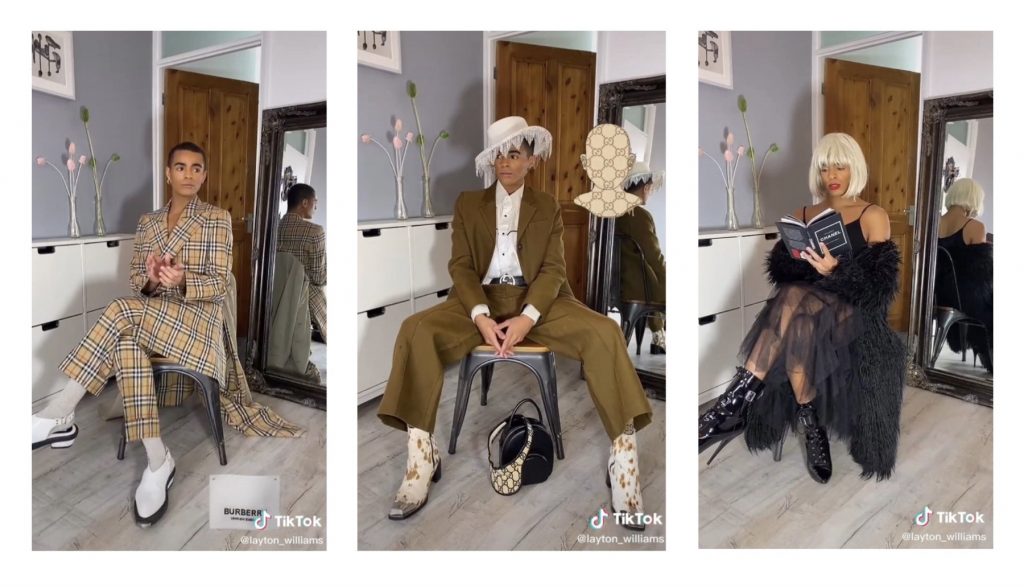
Through social media, specifically TikTok, Generation Z “Zoomers” place themselves at the front row of a Chanel haute couture show in their most luxurious tweed and envision themselves throughout the decades from a social outing to high school picture day.  TikTok is a social media platform that has been dismissed by some in the past for being seemingly frivolous and off-center; however, it is the creative outlet and imagined stage for many of Gen Z, who value individualism, democratization, and open mindedness. Youth users of the platform are able to construct their own fluid identity that is not restricted to gender, social class, or even time periods.

This fluid identity is essentially their “digital aspirational persona,” one where the users place themselves in every context that they want to be in without boundaries. The world is endless for this online generation—they romanticize and reconstruct vintage in a modern customization that brings the old to the new, and the new to the old, in a cycle of reinvention and recreation.

The typical fashion funnel is from haute couture to the mass market; however, youth culture’s aspirational world views have greatly influenced luxury fashion houses, with Gen Z emerging as the true trendsetters. Refinery29 states that Gen Zers are, “not only activists for individuality and inclusivity, but they assume all people have the freedom to define anything (and everything!) for themselves.”

The “Front Row Fashion Trend” on TikTok is one of the ways that users quite literally blur class lines by placing themselves front and center. Participants imagine what they would wear when attending a fashion show for various high end brands. Color-blocked Gucci, Versace gold trimming, Prada black patent leather, and airy white Jacquemus linen form the fabric for each individual user’s aspirational vision of themselves where they command attention and act as the Anna Wintour of their own worlds.

Rachel Fried of CRFashionBook comments on the viral challenge, “TikTok reimagines the margins of the runway, giving users the platform needed to curate their front-row digs even without the season’s invite. With the phygital (physical and digital) pretense of fashion holding strong, everyone now has the opportunity to indulge in the doom of Rick Owens; the bohemian tweeds of Virginie Viard, and if dared, the jacquard long johns of Miuccia Prada and Raf Simmons.” The democratization of fashion is fully present on the social platform and amplifies the democratization of the fashion industry in general.  It does not matter that most do not have the means, prestige, or class to be invited to a high fashion runway show, because they can just construct their imagined runway show with one click of their phone.

TikTokers move fluidly through time periods by imagining themselves in a vintage context where their world is romanticized and they act as the main character. Many TikTok users were born in the 2000s; however their own, self-identified personas. They meet a romanticized version of the 1950s in their modernized dirndl dress at a picnic in the fresh air and crocheted high-waisted pastel pieces for a beach day. They then move through decades from 1950s picture day to dayglo color palette jackets and voluminous hair for 1980s picture day to grunge leather jackets for ‘90s picture day. Within each digitally fabricated context, they also change their look based on imagined identities from goth, class clown, athlete, and jock to art student, cheerleader, and class president. These contexts are niche but expand the user’s individuality to cover spaces where they did not previously exist. This allows users to reconstruct a world where they exist in these spaces.

Reconstructing vintage is not only done metaphorically, but also physically through “shopping grandma’s closet” to bring new life to older pieces. Thrifting is extremely popular as the “thrifter”can take the basis of a style they like and customize it to fit their individual tastes. One user finds a tailored blazer in her grandmother’s closet and creates a casual edgy look by leaving the blazer open and pairing it with a black bandeau, ripped jeans, and a vintage beaded Prada bag. She also wears a slitted silk dress that may have once only been worn as lingerie. She then pairs a yellow double-breasted, puff-sleeve sweater with jeans, which is a fashion that has re-emerged this past year.  This represents fashion’s circularity; just as TikTok youth move fluidly through decades, so too does fashion to reveal an endless realm of archived identities that can be pulled out of the closet at any point in time.
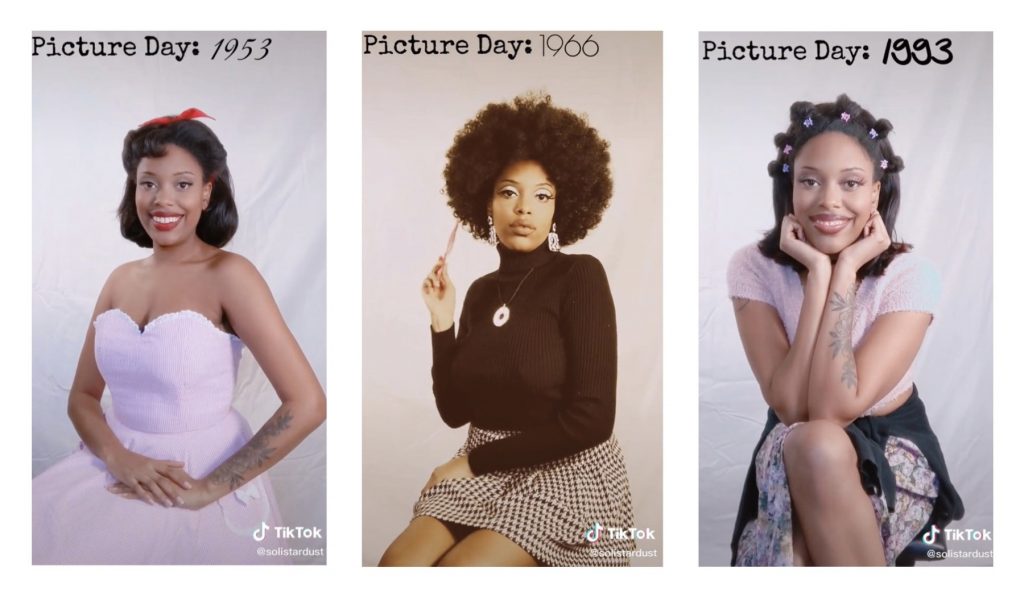
These vintage styles are tried by all different kinds of users, but those that seem to find the most power and identity in it are BIPOC (black, indigenous, people of color), especially Black women. Glamour magazine explains, “Fashion trends that romanticize historic moments are frequently problematic because by nature they exclude those who were disenfranchised during the period of inspiration.”

Media and education systems often exclude and erase the existence of BIPOC in the US during these romanticized time periods. When we think of the 1950s, for example, we often think of white women on screen from Audrey Hepburn and Grace Kelly to Marilyn Monroe and Sophia Loren. This whitewashing quite literally washes away identities of people of color, particularly Black identities. BIPOC, through TikTok trends, are constructing their imagined identity by writing themselves back into the narrative while deconstructing stereotypes in the process.

A noted example of this reconstruction is the “Black Girl Cottage Core.” Cottage core is a popular aesthetic for Gen Zers and usually showcases white women in western agricultural settings. However, Glamour says, “Take one scroll through Instagram, and you’ll find that Black women all over the world are inlaying themselves in the bucolic and pastoral imagery formerly obscured by whiteness. They’ve not only participated in it, but emerged as some of the most interesting ambassadors of the trend, using it to, in part, reclaim a history that refused to recognize them.” The way that Black women have embraced this trend directly debunks the dehumanizing stereotype that Black women are hard, intimidating, and unable to be gentle or ethereal.

Images courtesy of TiikTok

Gen Z is showing that they have the power to create powerful change using Tik Tok and other social media platforms. Their vintage fashion trends have designers re-releasing archived collections. On Farfetch’s best of archives, we can source from vintage Louis Vuitton monogram trunks, Givenchy 1980s chain link bracelets, and Chanel logo basketball and rhinestone basket bags. Gen Z leads the march toward social and political reform and circularity in fashion with their willingness to speak their minds—unless they receive the wrong dish at a restaurant, then they will just smile and eat it. We look forward to seeing the future of fashion when Gen Z takes the front row!


—Tessa Swantek

Spring 2022 Bridal Sketches

Whether the temperature in moderate or a little chilly, one way to know that spring is in the air is by all the planned weddings in the months of April, May, and June. And though the COVID-19 pandemic has put a damper on some spring nuptial plans, we are seeing some motivation and movement with some brides planning outdoor nuptials to promote safety protocols during this health pandemic.

That said, Fashion Reverie has curated a few bridal sketches from some of our favorite brands just give you a minor tease on what to expect from spring 2022 collections. Oh, the glory of it all, enjoy!!

Image courtesy of Ines di Santo

Ines di Santo

“I’m so happy to introduce the Goddess Collection for the Spring 2022 season. My brides are always my inspiration, each having unique qualities, and are modern-day goddesses in their own right. I created this collection in tribute to their limitless feminine energy. I want them to discover their own inner goddess.” —Ines Di Santo

Image courtesy of Jimmy Choo

Jimmy Choo, Atelier Couture

“The Art Nouveau collection is again a welcome challenge for us. The Atelier Couture created new designs and embroideries taking inspiration from beginning-of-the-century European artists that were inspired by nature. In fact, this is a delicate, dreamy, and innovative collection inspired by nature and art. We have experimented with new original embroideries, colors, and feelings. The result is ball gowns with architectural and romantic volumes where silk, tulle, satin, mikado gauze, and embroidery mix. We created a fluid and colored collection (that can be made in white too) with new patterns and unique details. This is a collection that brings hope for the future and gives joy to brides in their most important day” —Mr. Yew Loh, CEO of The Atelier Couture 

Image courtesy of Anne Barge

Anne Barge

“As the world looks ahead toward a brighter future, Anne Barge is thrilled to introduce a spring 2022 bridal collection that evokes optimism, opulence, and majestic romance. This collection celebrates the modern bride, delivering feminine, Parisian-inspired silhouettes, meticulous craftsmanship, and intricate details, perfect for creating cherished memories in the year to come. Spring 2022 debuts clean, architectural shapes in the finest jacquard, satin organza, stretch crepe, and silk Mikado, accented by gossamer illusion tops, hand beading, ethereal lace, and oversized floral prints. There is certainly something here for every classically chic bride looking to embrace newfound freedom to indulge in celebrating her special day.” —Shawne Jacobs, president and creative director of Anne Barge

Image courtesy of Lihi Hod

Lihi Hod

You’ve got to learn to appreciate the little things in life; like a good cup of coffee, or a fresh-smelling flower, or the smile of a stranger as you pass on the street.” The new collection is an invitation to enjoy the small moments in life and the beauty they convey: A celebration of a carefully crafted romantic style, attention to small details, and delicate artisanal work. The collection was designed with the female body in mind, combining luxury fabrics and haute couture—designed to celebrate love, a contemporary fresh interpretation of timeless wedding dresses with elegant French elegance.” —Lihi Hod

Image courtesy of PatBO

PatBO

“I am thrilled to enter into the bridal space with a beach-bound collection for spring 2022. It is important for me to dress the PatBO customer for all of her life moments from the bachelorette, wedding weekend, to honeymoon.” Patricia Bonaldi, founder and designer of —PatBO

—Staff

International Bridal Week: Spring 2022 Pre-coverage

Image courtesy of bridalmusings.com

When the birds start to chirp and trees and plants to start to bud, you can rest assured that spring has arrived. Another indication of the season of rebirth and rejuvenation is the arrival of International Bridal Week.

Though International Bridal Week occurs twice a year, it is perhaps the spring bridal collections that are the most dreamy and glorious. This year the bridal spring collections are digital and a week earlier than usual.

Once the COVID-19 health pandemic somewhat subsides, hopefully, bridal week will be back to runway shows and presentations. Bridal gowns need to be experienced in person with the current virtual presentations a vague, slim comparison to seeing those gowns flow and excite pulses in person. But what is an industry professional to do? Hmm, adapt!!

Fashion Reverie will be front and center, virtually, bringing our viewers great coverage of all things bridal for the spring 2022 bridal season. And maybe by the time brides are ready to show off their bridal choices in spring 2022, this crazy pandemic will be over!! Hope springs eternal.

William S. Gooch

Fashion Reverie’s Fashion History Quiz

youtube.com

Do you know who designed the little black dress that Audrey Hepburn wore in “Breakfast at Tiffany’s”? Who made the bikini popular 13 years or more after it was first designed? And, who was the first African American model to appear on the cover of American Vogue?

If you don’t know the answers to these questions and you work in the fashion industry, you should!! If you are not a fashion industry professional and don’t know the answers to these questions don’t go on “Jeopardy” if they have a fashion category.

In this season of change, growth, and evolution as we project into the future, it is important to look back at the past and reflect on what helped shaped the industry that we love so much. As the adage goes, without a knowledge of the past, you are doomed to repeat it.

That said, Fashion Reverie has curated some fashion history questions that reflect our incredible roots and illuminates the many vicissitudes of this industry. And for Gen Z consumers, remember, “knowledge is power.” Enjoy!!

Image courtesy of forbes,com

  1. Who created New York Fashion Week?
  2. Who invented high heels?
  3. Was pink clothing always associated with the feminine?
  4. What is the world’s oldest couture fashion house?
  5. In the 1940’s shoulder pads in women’s suits became a huge fad. What started this fad? 
  6. Which luxury fashion house was the first to develop a “designer fragrance”?
  7. Who created the now iconic “wrap dress”?
  8. How was clothing originally modeled and what famous fashion figure changed the modeling landscape? (hint: he is the creator of haute couture!)
  9. Who is the first American couturier?
  10. Who started the red-carpet question, “who are you wearing”?
  11. Who invented ruching?
  12. What is the French court of Louis XIV’s influence on fashion of today?
  13. Who designed Marilyn Monroe’s iconic white halter dress from “The Seven-Year Itch”?
  14. How did legendary hairstylist Vidal Sassoon change haircare? 
  15. What was “the Battle of Versailles” about, who were the players and why was it important for American fashion?

Answers:

Image courtesy of hollywoodreporter.com

  1. New York Fashion Week was created the first American fashion publicist Eleanor Lambert in 1944. It was originally called Press Week. 
  2. High heels were invented in the 15th century by Persian soldiers to secure their heels in stirrups.
  3.  Color associations in fashion change all the time. Blue clothing used to be associated with the feminine and was considered more delicate while pink clothing used to be associated with the masculine in its strong hue. It wasn’t until the 1940s that this association was flipped.
  4. In 1889, Jeanne Lanvin opened a millinery company, and expanded to a children’s “junior haute couture” company in 1908, and further expanded include a young ladies and women’s department in 1909 when she joined the Chambre Syndicale de la Couture.
  5. During the 1940s with tens of thousands of men fighting overseas, clothing manufacturers had a big dilemma. The men who would wear the suits they made weren’t there to buy them. Also, they couldn’t get shipments of fabric from Europe. Solution? Recut men’s suits for women. Designers shoved shoulder pads to fit women’s smaller frames. 
  6. Credit must be given to Paul Poiret, whose exotic designs were inspired by the mysteries of the Far East and who achieved recognition and applause for his art deco costumes for theater and ballet. Fascinated by the imaginative and ephemeral, he adored fragrance and became a perfume entrepreneur in the early 1900s. He established his own laboratory and facilities for blowing glass and packaging his “small wonders.” His company, Parfumes Rosine, was named for one of his daughters. 
  7. The wrap dress which initially was a form of a housecoat was worn by many women during the Great Depression. They were called “Hooverettes.” Elsa Schiaparelli in the 1930s and American designer Claire McCardell made a form of a wrap dress that was longer in length and wrapped around the entire body. However, in the 1970s, Diane von Furstenberg made the shorter length wrap dress that we are more familiar with.
  8. Models used to be a variety of different shapes and sizes depending on a brand’s typical client. Charles Worth, for example, was the first to use models over dolls for clothing and held the notion that women should be able to see themselves in a model which, in turn, sold more clothes. This is really interesting because today many consider plus-sized models to be a radical shift, which it is for our present time, but in terms of history, representation in terms of sizing was not unusual.
  9. Main Rousseau Bocher. He moved from Chicago to Paris in 1917 and worked as a fashion illustrator and editor before opening his own couture house in 1930. Main Bocher became Mainbocher (rhymes with “rain” and “rocker” for Americans, though the French pronounced it Mahn-bo-SHAY).
  10. Joan Rivers. In 1994 at the red carpet of the Golden Globes, Joan Rivers popularized this question by asking celebrities who they were wearing.
  11. Parisian couturier Madame Grès is credited with popularizing this design technique which takes pleated or folded fabric and gathers the fabric and/or pleats together, giving the effect of a waterfall or a layered effect. There is no exact evidence of who invented the technique; however, ruching techniques can be found in many cultures going back hundreds of years.
  12. The French court ruled by Louis XIV had a major influence on how we view fashion today. Known as “The Sun King,” he always dressed in elaborate costumes and allowed for France to become known as a fashion capital. Louis XIV and his finance advisor, Jean Baptise Colbert, started the concept of the fashion calendar, noting that textiles were to be released twice a year accompanied by certain seasonal accessories.
  13. Marilyn Monroe’s pleated ivory dress from “The Seven-Year Itch was designed by William Travila, professionally known as Travilla. He won an Oscar in 1949 for designing costumes for “The Adventures of Don Juan,” starring Errol Flynn. He also designed costumes for “Gentleman Prefer Blondes” and “How to Marry a Millionaire.”
  14. In the early 1960’s, Vidal Sassoon created what he called “wash and wear” cuts that didn’t require a large amount of styling or a trip to a salon, saving women hours getting ready. The popularity of pixie cuts skyrocketed after Mia Farrow had Vidal cut her hair for “Rosemary’s Baby.” As short hair cuts for women became huge in the early 1970’s, Vidal created androgynous geometric haircuts that could be worn by either men or women.
  15. The Battle of Versailles Fashion Show was a historic fashion show held on November 28, 1973, in the Palace of Versailles to raise money for its restoration. Created by Eleanor Lambert and Versailles curator Gerald Van der Kemp, the show pitted French designers Yves Saint Laurent, Pierre Cardin, Emanuel Ungaro, Marc Bohan, and Hubert de Givenchy against American designers Oscar de la Renta, Stephen Burrows, Halston, Bill Blass, and Anne Klein.

Staff


Insta-Gratification: Social Shopping

Image courtesy of fashion&style.com

Social media, particularly Instagram, has spurred “influencer culture.”  An influencer culture where a single aesthetically pleasing image of an influencer wearing a faux fur coat during Fashion Week can propel fashion lovers around the globe to search for similar styles and brand pages.

This short interaction can generate thousands in revenue for a brand through a single post. According to Launchmetrics, during 2019 Milan Fashion Week, Chiara Ferragni’s Prada outfit post generated a Media Impact Value of $475k with an increase of 24% in traffic to Prada’s website and a 200% increase in clicks on “headbands.” Despite staggering statistics, is this short-lived hype and does it only apply to a single item? Does social commerce only work for established brands? With the advent of Instagram “Shops,” “Checkout,” collection launches, and live story shopping tags, it is important to understand what value Instagram holds for the future of shopping for consumers and the future of selling for brands.

Image courtesy of skedsocial.com

In the summer of 2018, Instagram held a “Social Shopping Masterclass” in the presence of Madewell, Cynthia Rowley, and BirchBox among many others. Business of Fashion details the event by noting a remark by Vishal Shah, Director of Product for Instagram Business, “Shopping isn’t a linear journey. It’s not even a funnel, in the typical sense. We actually refer to it as the noodle. That noodle is about to become the way a big part of the world consumes.” This is an important consideration given that we now live in an omni-channel retail world where brands are expected to provide a seamless customer experience whether in a physical store, on an online shop, or on a social media page. Social media, then, plays an important role in this journey; however, can their role be even more influential in the future?

China is a master in providing this omni-channel experience by taking advantage of the “stickiness” of social media in its ability to grab and keep user attention in an addictive manner. Partially due to China’s governmental structure, they provide what Armando Roggio for PracticalEcommerce calls “The Stack,” which is made up of “social media, technology capabilities, content, and an owned retail channel.” On WeChat, for example, a single influencer can sell $60 million worth of product on a single livestream. WeChat alone “drove 250 billion in ecommerce in 2020. And for social commerce, many people expect the market to grow at a compound annual growth rate of 38 percent for the decade,” so it is critical for Instagram to latch onto this growth. With a well-integrated shopping platform, Instagram has the full stack with incredible potential to disrupt retail in the United States.

Image courtesy of ecommercechinaagency.com

BusinessofApps 2021 Instagram statistics report details metrics relative to Instagram Shopping. According to a survey, “54% of respondents said they bought something after seeing it on Instagram. 87% said they took some action after seeing product details on Instagram.” These actions include searching for more information, visiting brand websites, or visiting a retail store. It is clear then that Instagram plays a huge role in fostering action as well as significant conversions but is the value weighted toward larger brands? Is Instagram Shopping mainly limited to the product discovery of a single item without much value being attributed to continuous multi-item purchases and loyalty?

A look into Andrea Wazen, a small shoe business with growing popularity, offers some answers. Now, there is no doubt that Instagram offers a platform for small businesses to boast products and gain a following through aesthetics, awareness, and virality. According to Andrea Wazen in her interview with Business of Fashion, however, “consumers aren’t buying shoes directly off Instagram itself, at least not in large numbers. Customers use Instagram Checkout mainly to check prices before heading over to our own ecommerce site,” despite “100% of clients, whether in store or online, coming directly from Instagram.” There is clearly then a gap between Instagram’s shopping features and the consumer desire to make a purchase directly on the site. Instagram, in this case, is not the one-stop shop it attempts to be, but this provides a perfect example of the wonders of omni-channel retailing. Even though consumers leave Instagram’s platform before making a purchase, they still follow through along a noodle shaped journey to eventually make that purchase- in other words, a sale is a sale is a sale. Andrea Wazen benefits from this consumer journey that involves multiple touchpoints since consumers may have interacted with multiple products across channels; however, the experience is not necessarily optimized for the consumer whose experience could be made more efficient with less touchpoints. Dissonance then forms between the social platform and fashion brand with the need to merge the entire consumer journey onto the platform in a way that benefits both brand and consumer.


Image courtesy of @andreawazenofficial on Instagram

During Fashion Weeks this past and current year, Instagram has served as the hub for fashion content from inspiration to purchases. According to a spring 2021Launchmetrics report, “brands overall showed a 57% increase in their Instagram Owned Media posts which led to an increase of 131% in the total MIV® of Owned Media.” A particular spotlight can be shone on Burberry whose fall 2021 menswear campaign featured Instagram posts of primarily Asian celebrities dressed in Burberry taking pictures in branded folding chairs to signal their taking a virtual seat at the show. One post in particular, from NCT’s Jaehyun, a popular K-pop group member, earned over two million likes. These likes, however, do not necessarily equate to sales, but Burberry was certainly able to capture a large Asian audience which likely led to an increase in sales. A Jing Daily report, for example, marked Burberry as the winner of London Fashion Week in resonating with a Chinese audience. Instagram can serve a brand in creating fashion campaigns to foster sales in targeted areas when sales in other areas are lacking, especially during the current health pandemic. More established brands have an advantage in leveraging this ability; however, this does not mean that small brands cannot benefit from the platform’s features as evidenced by Andrea Wazen.

All-sized brands seem to benefit most from features on Instagram Stories in particular. Many fashion presentations in the past year have posted about presentations on Instagram with the ability to set a countdown to the show, as well as a reminder for users who may be interested in watching. According to Chantal Fernandez for Business of Fashion, “more users watch longform video and livestreams on the platform than they did before the pandemic with views up by 70%.” Instagram now features shopping tags for live videos and shoppable product tabs on the “Discover” page. These features essentially create the multi-channel presence on one channel; A user may watch a shoppable livestream, then visit that brand page, click on the shop tab to discover more products and make a purchase while staying on Instagram throughout the entire journey. This is close to the beauty seen in Chinese social commerce where every feature is in perfect harmony without ever having to scroll through different touchpoints.

Image courtesy of @_JeongJaehyun on Instagram

More sophisticated and integrated features mean a move from single product impulse buys to thoughtful purchases that span an entire product range. The future is that of a consumer browsing an entire collection through an Instagram story on the “Discover” page, viewing the integrated website through the “Shop” tab on Instagram, then checking out on the site without ever leaving. A consumer may also see an item they like and immediately buy. This purchase may cause the same consumer to scroll through the “Shop” tab to go through the discovery phase post-purchase which can cause more frequent purchases. The “Discover” tab then reflects this interest and promotes branded products to create a loyal consumer. The omni-channel strategy can essentially be replicated on a single platform. This strategy would be made even more effective through features that are aimed at increased personalization which Instagram has the consumer data to be able to develop. With more perceived channels, Instagram can get even closer to disrupting social commerce in the U.S.

—Tessa Swantek

The Modern Fashion Model, A Fashion Reverie Series: Part 2, Plus Size and Transgender Models

Image courtesy of pagesix.com

The second installment of this series focuses on the experiences of three plus-size models and a transgender model.

The issue of “fairness” and inclusivity has been top-of-mind for the general public for the past three years. In 2020, the tragic murders of George Floyd and Brianna Taylor shocked the world to its core and the COVID-19 lockdown gave us the time to consider how inclusive we are as a society. The fashion world was no exception, and we began seeing more models of varying ethnicities, size and genders in fashion shows and editorials. Previously, plus-size and trans models with notable exceptions—Ashley Graham being an exception—and had been relegated to fringe status. Fashion Reverie spoke with three plus-size models and a transgender model who have all experienced success in their respective modeling careers. In candid conversations with Fashion Reverie, they shared success stories, how they are treated, challenges they face and weight-in on how inclusive the fashion industry is for plus-size and trans models.

MEET OUR ROUNDTABLE PANELISTS

Emma Schlichting is a plus-size and fit model who has worked with Old Navy, Stitch Fix, Levis, Alpine Butterfly Swim, and Ad Black, a feeder brand to Target as a fit model. She starred in Episode 5 of the new Netflix Series, “Next in Fashion,” hosted by model and fashion designer, Alexa Chung, and Tan France, fashion designer and TV personality from “Queer Eye.”

Instagram: @emmaschlick

Plus-size Model Kimberly E. Stone has over ten years of experience modeling as a size 4 model and more recently as a size 12 plus-size model. She was called “ethnic” early on in her career, and is now referred to as “BIPOC,” a new category for women with “textured” hair and a face “of color.”  She is editor-in-chief of POSHGLAM and is working to relaunch POSHGLAM as an app in 2022. 

Instagram: @kimberlyestone

Liris Crosse is referred to as “the plus-size Naomi Campbell.” In 2017, she was the first plus-size model to win the “Project Runway” Model Competition. Liris is also the first plus-size and Black model to partner with a bridal brand; she works closely with Maggie Sottero bridal.

Instagram: @lirisc, www.LirisC.com, and www.LOAWMBC.com

Ale Tristan is a Mexican transgender model who holds the title for Miss Trans Star USA 2019 and was a runner-up for Miss Trans World 2019. She has also walked at the Milan Fashion Week fall/winter 2020 shows. Her motto is, “Any change starts in your mind.”

Instagram: @ale_tristan_

Fashion Reverie: Who gave you your first big break?

Panelists: Emma, Kimberly, Liris, Ale

Image courtesy of JE Model Management

Emma: A family friend told me I should model. I looked at model management companies in San Francisco and went to open castings with digitals my Mom shot and developed at CVS. I didn’t know anything about the industry. I’ve been with JE Models, a boutique agency since September of 2017. I book a lot of fit modeling work.

Kimberly: I’m from Atlanta and was going to modeling competitions in malls. I studied at New York University and Baruch College, and the advice I got was to try modeling and to give an agent a year to get results. I’ve gotten a lot of commercial work, also called “slice of life.”

Liris:   I went to an open call for a models’ convention called Model Search America while in high school. They picked me to come to the regional convention to walk for the agencies.  I got callbacks from Elite, Zoli, Michelle Pommier, and Seventeen Magazine, but they all wanted me to lose weight.

After graduating, I moved to New York to pursue commercial modeling. Model Search America set up a meeting for me at Wilhelmina’s Curve division. They offered me a contract that day and my career started. I didn’t even know plus modeling existed; I was just excited to be signed!

Ale: I don’t even know how that happened, well no, I worked for it and then I went to Europe to participate in the Miss Trans Star USA pageant. When I won, I had already been through the transition. I started by accident, designers liked how I looked, but I was not out looking for a modeling career.

FR: Are modeling agencies and social media important to your career?

Panelists: Emma, Kimberly, Liris, Ale

Emma: I did go to an agency that had a curve division. They liked me as I was, I’ve got a sporty body, am a skateboarder and a bit of an adrenaline junkie. That said, I haven’t been pushed really hard by my agency.

I signed with Breakwall West in Manhattan Beach/LA that has big clients and connections, then the COVID-19 pandemic hit. Since moving to LA, all the jobs I’ve booked happened via Instagram. Social media made me more comfortable to be in front of the camera. Clients started reaching out to me on social and I booked Machines for Freedom (a bike apparel company), a video for Stitch Fix and the spring campaign for Old Navy, all through my Instagram.

My San Francisco agency booked me for Beta Brand and found me through my Instagram. I’m at the point of questioning if I even need an agency.

Kimberly: I’ve had over 12 agents. An agency protects you from the wrong photographers and plays a huge role in a model’s career and development. I had it easier being fair skinned with light eyes when I started. Now, beautiful Black women are being celebrated and women can wear their hair natural.

Social media was very helpful when I had my own wordpress site, (poshglam.tumblr.com); It helped draw attention to my brand. I’d love to have more followers but am more focused on being a personal brand right now.

Liris: We live in a social media age where clients go to your Instagram before they even peek at your agency profile. Agents are still important because I can just focus on my art instead of also having to be the accountant, salesman, and secretary. They know about rates and usage and having one keeps a level of respect and mystique for a model. I’m thankful for my agent Dorothy at Dorothy Combs Models.

Ale: I do it all myself, no agency. It’s pretty much social media, that’s how people reach out to me. There are agents sending messages and I’m like, “no thanks.”

FR: Please comment on fairness and inclusivity in fashion and the recent interest in plus-size and trans models. Is it a trend with legs or just a fad?

Panelists: Emma, Kimberly, Liris, Ale

Emma: It’s money motivated but also rooted in some need for change. As a plus-size person it’s important to see plus-size models. It’s making a difference for people who can see themselves in ads. Victoria’s Secret lost so many sales because they weren’t inclusive about size and are so fat phobic that they’re willing to lose sales. They’re the anomaly.

There’s a bigger message of, ‘Be who you are, who you are meant to be.’

Some of us are never going to be tiny, it’s just genetics. There’s so much overlap with Influencers and they are getting work as models. The two go hand in hand especially with COVID-19. Some people have set up studios at home to shoot E-com at home for brands.

It’s also about if a brand is going to extend their plus size offerings, and finally give attention to the plus-size community. I love that I’m a part of the process when I give my feedback. Also, plus-size wouldn’t exist without the Black community that has always celebrated curves; we’re finally started to learn from that.

Kimberly: No, I don’t, my agent told me to lose weight.  I’m researching cool sculpting and liposuction to maybe get back to a 4.  Ashley (Graham) and I don’t carry the weight the same way, mine is in my midsection. I’m in the process of changing agents and am getting new pictures as a plus.

I’m also hard on myself, to be honest. I’ve always felt like Euro centric standards of beauty prevail, but I’ve had success as a girl who’s ‘ethnic ‘or ‘exotic.’ Commercial work is what pays, and I’ve done well in that “slice of life” space. I may venture out as an older model, we’ll see.

Image courtesy of Beyond Fashion Magazine

Liris: It has made some impact, but the long-term proof will be in the continuous actions not just words, and pray we get to the point where we aren’t surprised to see models of various shapes, sizes, and ethnicities in magazines, campaigns and shows. It’s just more of a simmering fire on the stove of fashion. Social media has given consumers a voice to speak up for diversity and what they want to see. Society is a lot freer now and they don’t want the old structures of fashion and advertising, anymore. 

Ale: Right now, with all those movements, it’s Black, inclusivity in everything. There are some genuine people, but a lot want to get the attention for using trans. Social Media gives minorities a way to fight back. Everyone is different and how you want the result to be and how you envision yourself, which includes the surgeries you want to get. At the beginning, I wanted to be known for being trans, but now I want to be known as myself. After a while, it takes away something from me and some of my essence. The tag ‘trans,’ pigeonholes you.

FR: Is the pay scale for plus-size and trans models equal to that of “regular” models? Are you getting equal pay?

Panelists: Emma, Kimberly, Ale

Emma: My rate is $187.50, and my takeaway is $150/hour when I do fittings. Not a lot of people know about this and it’s under-appreciated especially in the plus-size arena. I’ve noticed that some brands have a bunch of girls of the same size who are different body types, which make sense; plus-size women come in different shapes. I get to give feedback on the fit, it’s all about the user experience which can be different for the plus-size person.

Kimberly: I think I’m getting the going rate. When I did the soccer pictures my agent was able to get me the going rate.

Ale: I think it’s equal, at least for what I did at Milan Fashion Week.

FR: What are your best and worst experiences as a model?

Emma: I got booked for the Netflix series, “Next in Fashion” and then was told it would be “the underwear episode.” I had a little breakdown in the Target fitting room trying to get my nude underwear just right, but was okay when I realized that I was doing it for little girls who need to know beauty comes in all shapes and sizes.

My designers were great. Then, one of the stylists decided to switch out my size 11 shoes for huge size 13 ones with massive heels for the rehearsal. This was my first real runway job, and it was on Netflix! I could barely walk the next day, but it was the best and hardest day yet.

Liris: The unique experience of working on “Project Runway”, season 16 when I became one of the first plus models to win the model portion. As a plus-size, it was big to walk designer looks weekly, and to be at the New York Fashion Week (NYFW) finale. My presence on that show got respect for plus models for our runway walks and our body confidence. It gave me a platform to speak up for the plus-size woman consumer and that’s priceless.

Ale: Milan Fashion Week in February was my first big one; I was there for the February 2020 shows. My being there for shows just happened. I was in Europe for the Trans pageant and the designer (Steven Vazquez) was there dressing someone.  He said, “Wow, who are you?” and invited me to walk his show.

While there, I also got hired to walk for other designers. I don’t think it mattered if I was trans. That was great, having designers want you because of how you look. But once they know, there were the people who reached out to me, saying, “Because of all the things that are happening right now, we need a trans girl.”

FR: Is modeling your ultimate career aspiration?

Panelists: Emma, Kimberly, Liris, Ale

Emma: I plan to keep modeling but am not pursuing it full time. I don’t really have a dream modeling job but would love to shoot for Target and other big brands that have influenced my experience as a plus-size model.

Kimberly:  I want to book the Victoria’s Secret show. I’m doing a photo shoot, with Laretta Houston, who shot Tyra Banks for Sports Illustrated, to freshen-up my portfolio as a plus-size. An agent reached out to me for a national accessories campaign, and I’m communicating with the casting director. I’m still working on landing my big break in acting or modeling and I’m going to keep working.

I’m also an inventor of pants called ‘sexy shapers.’ I’m also launching POSHGLAM as an app; it’s in the wireframe stage now.

Liris: I keep booking great jobs, and recently became an ambassador for Athleta. They just released over 350+ styles for sizes 1x-3x available in store and online.

I also have a business, Life of a Working Model Bootcamp, birthed out of so many models asking me how to break into the business or how to up-level their careers. I have classes from how to get started to perfection in posing. I’ve had models who completed the bootcamps sign with major modeling agencies and walk NYFW shows!  Course dates are on Life of a Working Model Bootcamp on Facebook.

Image courtesy of pinterest.com

Ale: I have modeled for fun, not as a career. What turned me off was being looked at as an object. They wanted to say I was trans, not that I care, but I don’t want to be used.  I’m trying to focus more on the hair extension business I want to open in Washington, D.C., but I would do a campaign to help bring awareness to black trans women being killed. When I watched “Pose” and the character Candy was murdered, and the police didn’t do anything, I cried.

—Vivian Kelly

For Spring 2021, Illuminating Yellow and Schiaparelli Pink: Color Rejuvenation

Images courtesy of runwaymagazine.com

Coco Chanel has been quoted as saying, “Women think of all colors except the absence of color. I have said that black has it all. White too. Their beauty is absolute. It is the perfect harmony.” Now, it is agreed upon that there is a certain timeless chic to black and white, but isn’t there fun in wearing that bouncy yellow dress on a sunny summer morning? (Coco Chanel may be eloquently scoffing.) Even Chanel’s haute couture spring 2021 presentation reflects this sentiment in glittering technicolor as a noir et blanc screen transitions into a palette of pink sparkling tweed, deep olive trim, and robin’s egg tulle.

As described by verywellmind.com, “Feelings about color are often deeply personal and rooted in experience or culture, for example, while the color white is used in many Western countries to represent purity and innocence, it is seen as a symbol of mourning in many Eastern countries.” Though there certainly is cultural significance relative to color, certain associations can be made across borders and have been applied in art, marketing, and fashion. Red, for example, “is considered the warmest and most contradictory of the colors. In fact, this fiery hue has more opposing emotional associations than any other color: Red is linked to passion and love as well as power and anger.”

Images courtesy of pantone.com

Orange and yellow, also being warm tones, command visual attention and evoke strong responses of happiness, alertness, enthusiasm, and energy. Cool tones, blue, purple, and green, are often regarded as less visually stimulating, but still carry strong associations and cues. Blue and green are often considered to be conservative hues in their associations with stability, calmness, and safety; however, they are also associated with strong emotions such as sadness and envy. Purple, on the other hand, elicits powerful more abstract connections from wealth and royalty to mystery and imagination.

Color preferences in fashion choices often make a statement about how one would like to be perceived. verywellmind.com states that someone who wears white may wish to be viewed as youthful and modern, while someone who wears black may want to be regarded as sleek, powerful, and sexy. Color preference may also change significantly as a buyer gets older, for example, “a person might prefer brighter, more attention-getting colors when they are younger, but find themselves drawn to more traditional colors as they grow older,” explains verywellmind.com.

Images courtesy of pantone.com

Pantone, leading color forecaster, releases trend reports annually and seasonally as they relate to fashion, beauty, and interior design. Traditionally, color palettes that Pantone releases are highly associated with the fashion season. Fall/winter’s palette is often composed of muted cool earth tones while spring/summer’s palette is linked with warm vibrant tones. These seasonal lines, however, have been blurred and form a “pantone” of color.

 According to Pantone Color Institute experts, “the color palette for spring/summer 2021 New York Fashion Week (NYFW) emphasizes our desire for a range of color that inspires ingenuity and inventiveness—colors whose versatility transcend the seasons and allow for more freedom of choice—colors that lend themselves to original color statements and whose flexibility easily adapts to our new and more fragmented lifestyle.”

Images courtesy of pinterest.com

The pandemic, despite its associations with solitude, sickness, and fear, has been met and contrasted with vivid colors in the fashion industry. This offers an interesting perspective as it seems that people are dressing in bright colors during the pandemic in an aspirational nod to rejuvenation, hope, and an optimistic future. Leatrice Eiseman, Executive Director of the Pantone Color Institute, speaks to this in the color palette curation by stating “colors for spring/summer 2021 combine a level of comfort and relaxation with sparks of energy that encourage and uplift our moods.” The color of the year, “Illuminating” yellow, offers a warm outlook on the future and is described as a “color conveying a message of strength and hopefulness that is both enduring and uplifting” and is complemented by “Ultimate Gray,” which “quietly assures, and encouraging feelings of composure, steadiness and resilience” at a difficult period of time.

Images courtesy of cfda.com

There is historical precedence for this seemingly contradictory phenomenon, especially in the period of recession during the 1930s. Despite the despair of the Depression, colors were rich and represented how Americans could control some sense of joy in their everyday lives despite a bleak macro-environment. A noteworthy example is Elsa Schiaparelli’s creation of the iconic “Schiaparelli Pink” in 1937 at the precipice of WWII and the aftermath of the Great Depression. According to CR Fashion Book, “Using bright colors, especially pink, was a way for Schiaparelli to disconnect from the global conflict at hand and find a source of inspiration. The shock value of her designs challenged the preconceived ideas of color, especially pink, and set her apart as a designer.” Similarly, during the pandemic, we are seeing distinct color combinations from many well-established brands as well as newcomers. It will be exciting to see which designers achieve traction with consumers and what might be the resultant evolution of this color story.

Image courtesy of Meagan Morrison

Of course, artists are well versed in the emotional power that color can reflect and illicit. Much like Schiaparelli, Meagan Morrison of Travel Write Draw, traveling fashion illustrator, makes use of color to lift us out of our worries into a ray of optimism and light. She says, “I consider myself to be an eternal optimist and have always been drawn to bright, vibrant colors. I insisted my childhood bedroom walls be painted butter yellow so that no matter the weather, it would always feel like the sun is shining in my room. I feel like people are drawn to my work for that same reason. The instant burst of joy you feel when you look at the plethora of color and expressive brushstrokes has the power to heal.”

The power of color to heal, revive, and rejuvenate is never more important than in times such as now. We could all focus on gloom and doom, or pick ourselves up, put on our prettiest pink, or happiest yellow and move forward, heads held high.

—Tessa Swantek

New York Fashion Week Fall 2021 Sketches

All of us would like to get a jump of what some New York Fashion Week (NYFW) fall 2021 collections will look like this season. Well, that sneak peek is possible.

Every season, Fashion Reverie publishes a few sketches from some fashion designers that suggest the inspiration behind their upcoming collection. This season is no different, Fashion Reverie has a few designers that gives viewers a slight glimpse into their fall 2021 collections. And most of them a new to this sketch preview.

Image courtesy of Bibhu Mohapatra

Bibhu Mohapatra

Bibhu Mohapatra is no stranger to Fashion Reverie’s sketch preview. For his fall 2021 collections, Mohapatra looked to the sanguine spirt of the 1920s. “As we sanguinely enter the `20s of this century with hope and optimism, history is made,” explains Bibhu Mohapatra. High governing power is entrusted with the task of leadership of women who are no longer nameless or invisible. These women are the modern-day muses and role models of our time.

The quote melds perfectly to the time we are living in. With Kamala Harris, who is of South Asian descent, assuming her roles as Vice President of the United States, there is no wonder that Mohapatra, who is also South Asian, to be inspired by her ascent. Fashion Reverie expects this fall 2021 collection to contain a bevy of beautiful gowns that will combine a 1920s aesthetic and some South Asian influences. And wouldn’t it be great if VP Harris dons one of Bibhu Mohapatra’s gowns for some of those formal state dinners.

Image courtesy of Epperson

Epperson

When we asked for details of his upcoming fall/winter 2021 collection, Epperson replied, “Each season is like another paragraph added on to my story. I am a smaller designer. I try to choose fabrics that are not complicated to get: wools, cottons, silk taffeta, and muslins, and treat them to wash and wrinkle. Mixing that with the shape I’m going to make them into makes them uniquely mine.”

Epperson notes that “Women are always wearing armor.” He’s created breastplates out of a lattice of interwoven woolens, much like an oversize vest on one side and several other pieces forming the other.  He likens these garments to a shield of honor. While the collection is basically black, it’s not somber. The designer describes his latest work as solid.
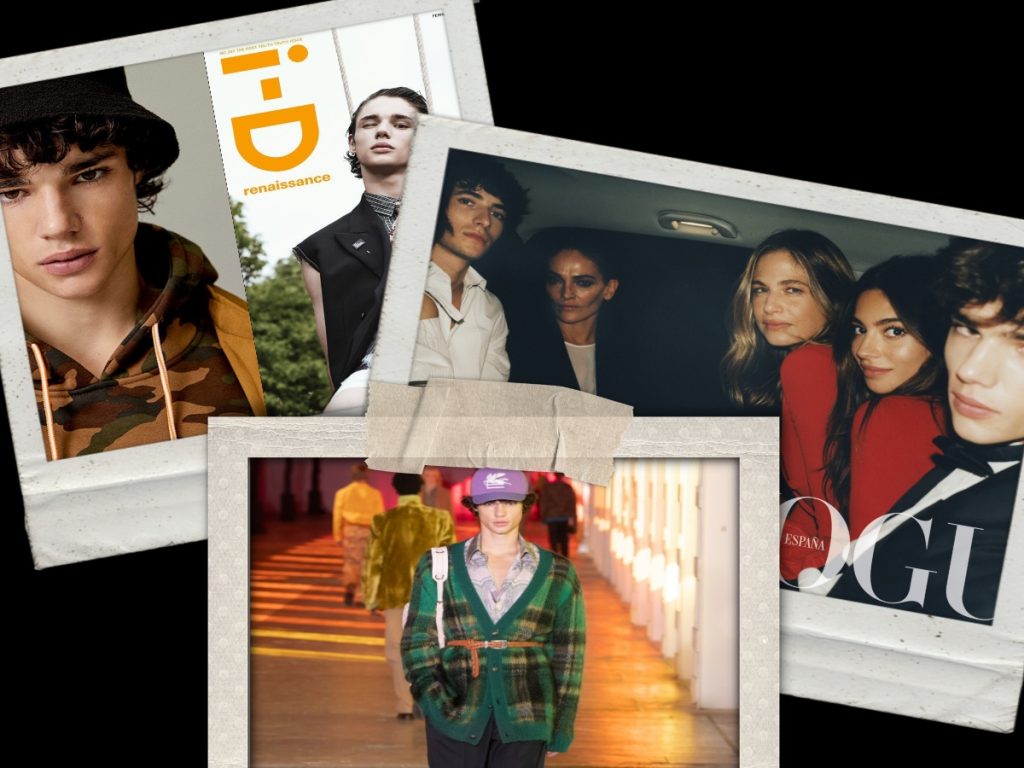
Image courtesy of ADEAM

ADEAM

As with every collection, ADEAM’s fall 2021 collection draws inspiration from Japan, designer Hanako Maeda’s home country. For this collection, Maeda is inspired by Japan’s contemporary art.

At the of 2020, Maeda visited the STARS exhibit at Mori Art Museum that showcased the works of six artists who shaped Japanese art from the 1950s to the present. This idea of bringing traditional Japanese artistry to the modern international audience inspired the fall 2021 audience.

This season, Maeda concentrated on craftsmanship which lead to the fabrication of crinkle-pleated poplin. As well as other pleated fabrics in the collection. The color palette this season is inspired by washoku—scarlet red, violet shades, muted rose quartz and ice blue—the traditional colors of Japanese nature.

Image courtesy of Thale Blanc

Thale Blanc Statements

Deborah Sawaf will be showing spring/summer 2021 this month, as she is a designer who shows to season. Deborah believes that women want to wear something simple yet beautiful. “They want to get out of the basic pants they’ve been wearing for months on end.” She opines that women, especially moms, are going to try to keep the model of working at home, if their children need to do the same. “A key piece that speaks to this aesthetic shift is a kind of track pant with a Euro/LA twist that I believe will be the piece of the season.” The collection this season is going to be different, yet not over the top and flashy. “This is a time when we need to be careful, mindful and real in our approach to fashion.” Deborah hopes to show live in September, but always wants to do something a little bit different. We can’t wait to see the ongoing evolution of this brand.

Image courtesy of APOTTS

APOTTS

Aaron Potts launched his eponymous brand in 2018 after graduating from Parsons School of Design and working Anne Klein, Emanuel Ungaro, Ellen Tracy, Kaufmanfranco, Badgley Mischka, and Escada. APOTTS embodies unisex sensibility and practicality while maintaining a focus on creativity and diversity.

This fall 2021 collection if for all genders, sizes, and ages. Real style is about spirit, not about physical differences, or trends. This collection is clean, modern trans-seasonal clothes that become a uniform.

—Vivian Kelly and William S. Gooch

Fashion Reverie’s Model Watch: Fall 2021

2020 has brought a crop of models who are the ideal—they can walk a runway, shoot a look book, and become a memorable character in a magazine editorial. Each of the models on our list possesses that compelling quality that pulls you in and leaves you wanting more. Meet our model class of 2021.


The Men

Maurits Buysse

Mother Agency: IMM Bruxelles (Brussels)

Instagram: @mauritsvbuysse, 1,037 followers

This young Belgian was scouted in Times Square and went on to walk in the Dior, Hugo Boss, and Louis Vuitton spring 2021 shows. His booker, Hugo, tipped us off that he is featured in a short film, “Behind the Blinds” coming out this spring. In his downtime, Maurits designs clothes, and prepares exotic dishes in his kitchen.

Fernando Cabral

Mother Agency: Marilyn Models

Instagram: @fernandocabral07, 16.9K Followers

This Portuguese native’s recent modeling work includes “The Trench” campaign for Matches Fashion, and the Etro fall/winter 2020 campaign. He’s had editorials in Purple, Elle Romania and walked the spring/summer 2021 Fendi show. In addition to a growing list of impressive editorial work, Fernando is an entrepreneur.

Fernando Lindez

Mother Agency: Uno Models (Barcelona)

US: Wilhemina Models LA

Instagram: @Fernando_Lindez, 205.7k Followers

This Spaniard is on a roll: he’s currently one of Models.com’s top 50 ranked models.  Fernando possesses a compelling beauty that is part waif,  part pretty boy, and all heart throb. His bookers refer to him as “el guapo” (the handsome one). His editorial work includes Vogue Espana, and Esquire Spain. Fernando just won the Reader’s Choice title for “Breakout Star: Men” in the Models.com Model of the Year Awards 2020. He’s walked in the Jacquemus, Versace, Isabel Marant spring/summer 2021 shows, and in Etro’s fall/winter 2021 show, and also stars in the Ami Paris campaign. We’d love to see him come stateside for New York Fashion Week (NYFW) week in September.


The Women

Alexa Kissling

Agency: Marilyn Models

Alexa is a versatile model who can go from Grace Kelly or Tuesday Weld debutante to a punk princess in a heartbeat. Super stylist, Mimi Lombardo, brought her to our attention as one to watch. Her recent editorial in Billy Magazine shows-off Alexa’s range. While she’s currently a dark horse, we look forward to seeing what she’ll book in the coming months.

Mao

Agency: Metropolitan Models

Instagram: @xingxingmao1, 21.9k followers

Mao is one of the few Asian models to gain significant traction in the fashion space. She’s starred in a head-turning number of campaigns including Max Mara, Louis Vuitton, Chloe, Maison Margiela, Prada, and Diesel X Coca-Cola. Her ability to transform herself into a brand’s ideal woman has also earned her turns walking for Louis Vuitton, Paco Rabanne, Max Mara, and Fendi at the spring/summer 2021 fashion week shows. 

Sihana Shalaj

Mother Agency: Scouted by Mollie (London) and IMG Models

Instagram @sihana, 4.03k followers

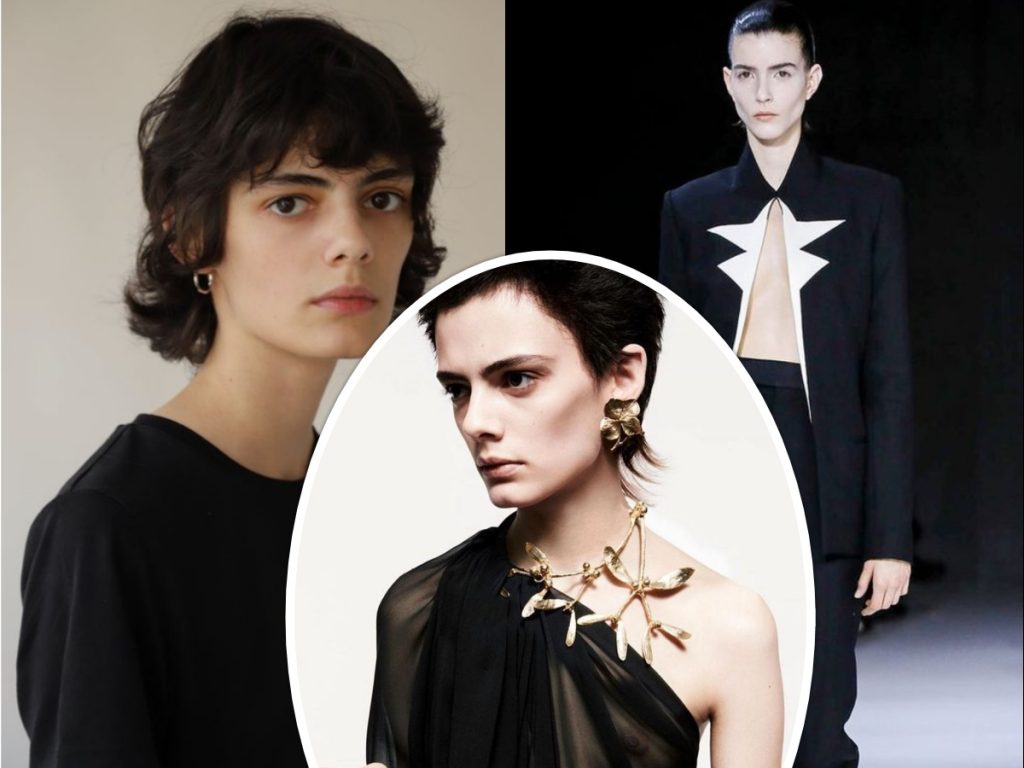
This Kosovo raven-haired beauty has an old-time Hollywood male screen idol’s cleft chin, heavy brows, and intense brooding eyes that grab one’s attention, even in a simple run of the mill headshot. Highlights so far include walking the Saint Laurent spring/summer 2021 and Haider Ackermann fall/winter 2020 shows. She’s also got one of the coveted Saint Laurent look books under her belt (summer 2021), as well as Givenchy pre-fall and spring/summer 2021. Indie magazines i-D and Pop have shot her, celebrating her stark androgynous look styling her as a young Patti Smith.

Joanna Krneta

Agency: One Management New York

Instagram: @jkrneta, 4,898 followers

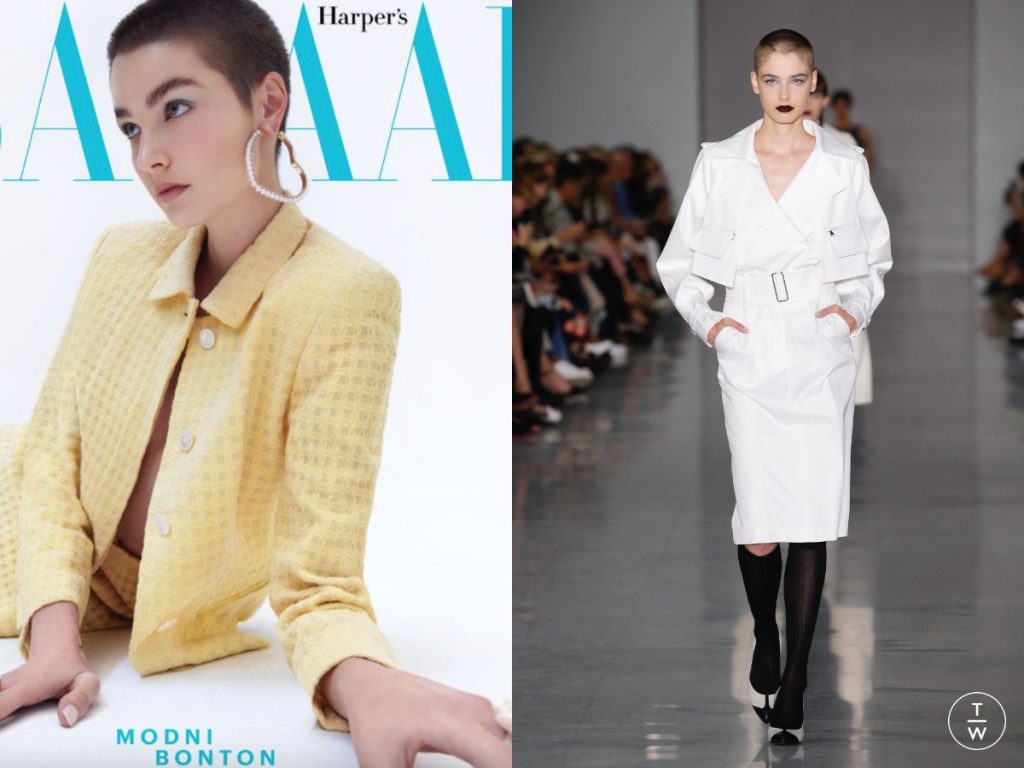
Joanna’s austere punk gamine look speaks to fashion’s ongoing love affair with androgyny. With her shaved head, she resembles a modern-day Joan of Arc. So far, she’s walked Armani Prive Haute Couture spring/summer 2021, and the Gabriela Hearst spring/summer 2021 shows. Her cover for the Harper’s Bazaar Serbia’s August 2020 issue shows-off her potential. In addition to modeling, this Serbian beauty is an Irving Penn enthusiast and budding artist.

Sacha Quenby

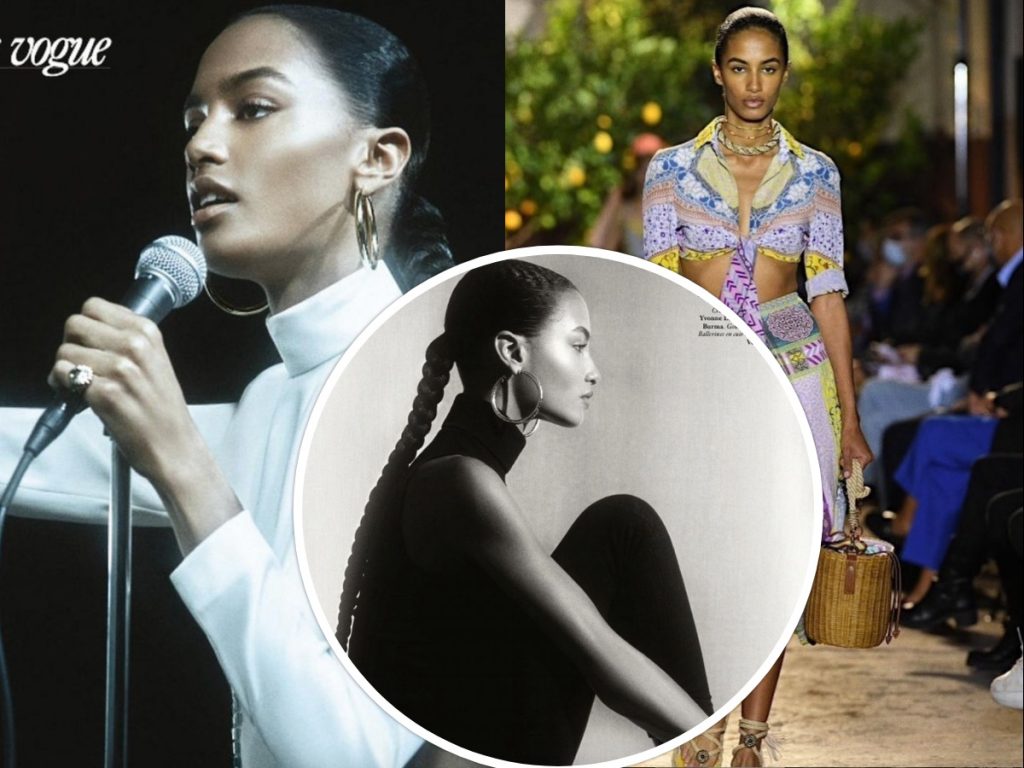
Mother Agency: The Squad (London)

Instagram: @sachaquenby, 5.48K followers

Superstar makeup artist, “Mother” aka Pat McGrath, and stylist, Carine Roitfeld, are both fans of this elegant British beauty. Sacha has the striking bone structure of a young Iman (Mohamed Abdulmajid-Bowie) and shows that she can cover a range of characters. She depicts a Sade-like chanteuse character in “Sweetest Taboo” for Vogue Paris’s November 2020 issue. Sacha plays an elegant bourgeoise at the Bottega Veneta spring/summer 2021 show, and a beautiful gypset princess at Etro‘s spring/summer 2021 presentation. Her co-starring role in Zara’s ‘Amazing’ fall/winter 2020 campaign shot by Steven Meisel, rounds-out her growing portfolio of work.

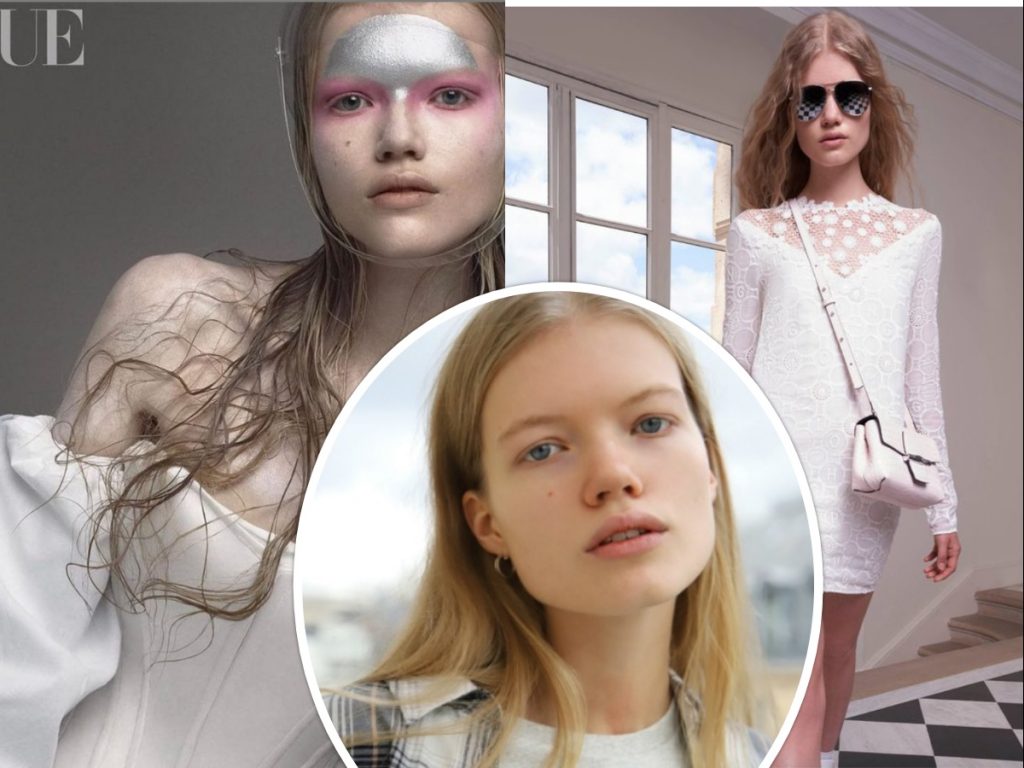
Madeleine Fischer

Mother Agency: Women Model Management

Instagram: @madeleine_fs, 1.60k followers

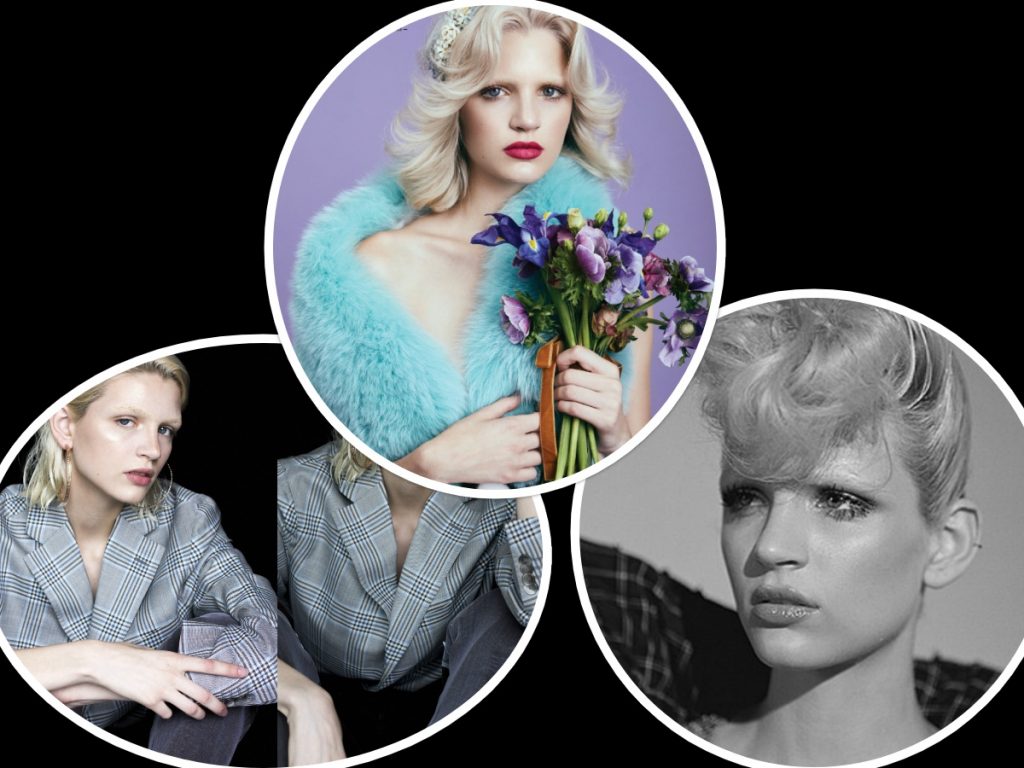
At first glance, Madeleine looks like just another cute blonde California skater girl you’d see on the Venice Beach boardwalk.  On closer inspection, this Berlin native has the innocent vibe of a young pouty lipped Kate Moss. Both can go from cool edgy downtown girl to bourgeois princess in the blink of an eye.  Madeleine’s waifish looks landed her on the cover of Harper’s Bazaar Germany’s October 2020 issue, and got her work with dream team Mert Alas and Marcus Piggott for British Vogue. Madeleine has also walked in the Chanel spring/summer 2021 show and the Longchamp spring/summer 2021 look book further rounds-out her budding portfolio.

—Vivian Kelly

Copyright © 2012-2025 | Fashion Reverie Publications, LLC - All Rights Reserved