 It’s a huge challenge to produce and mount plays that tackle the difficult subjects of slavery and/or race relations. There is always the problem of theatrical voice, sensitivity, and racial currency. Race relations and slavery are very sensitive subjects for the theatre to take on. And even though slavery in the US ended over 150 years ago, racial discrimination and inequity continues for African Americans.
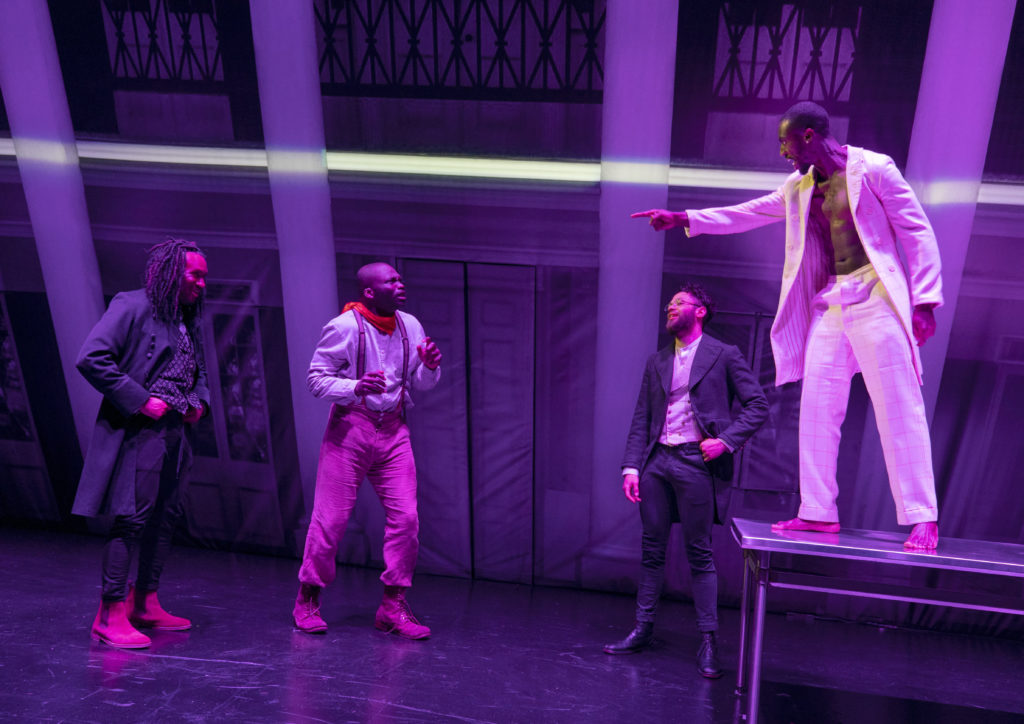
Thomas Bradshaw in his 2008 play “Southern Promises” re-examines slavery and the residual effects of such a brutal social and economic system of oppression. In this production of “Southern Promises,” The Bats, the resident acting company at the Flea, boldly revisits slavery with an interracial cast that contains people color playing both the servants and the dominant class.
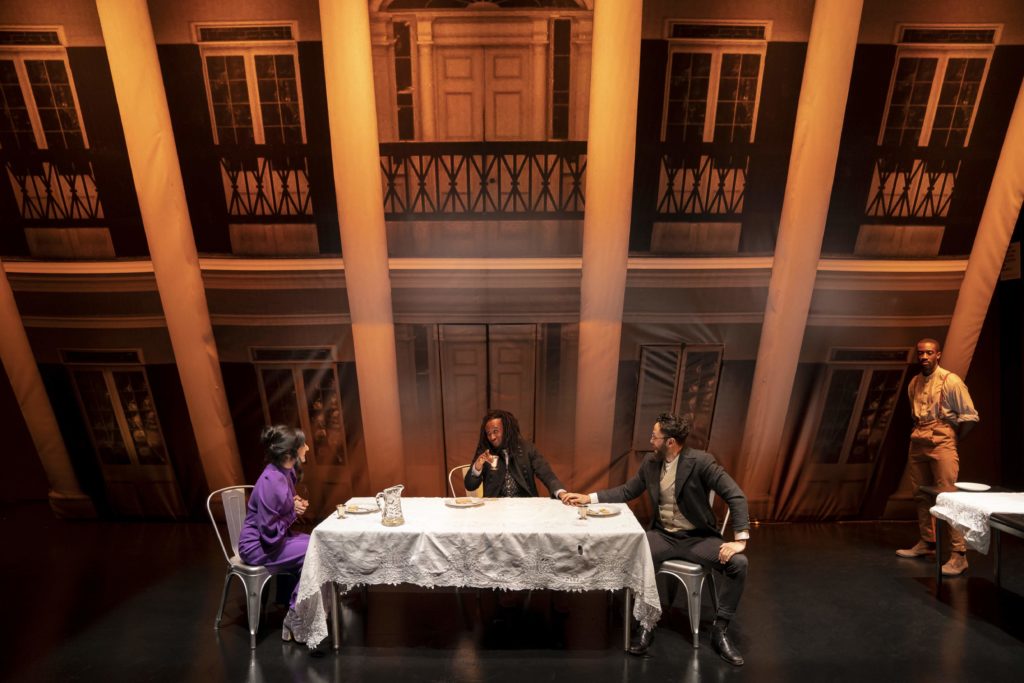 “Southern Promises” centers on a promise made by the dying plantation owner that his slaves be set free after his death. Though the plantation owner wills manumission of his slaves in his will, the patriarch’s wife goes against his will, literally, and keeps the slaves in bondage, contributing her dead husband’s desire for manumission to his fevered dementia at the end of his life.
There are many things in this production that serves this incendiary subject in a great way. Though the utilitarian set is almost stark with a plantation backdrop, it is surprisingly functional and serves the production adequately.
The Bats acting company takes on all the characters and though some of the black actors play white antebellum roles, the non-traditional casting does not detract from the incendiary nature and forcefulness of the script. One wonders if Bradshaw was inspired or drew reference from Jean Genet’s iconic play “The Blacks,” where the blacks actors took on the roles of the black and white characters. Whether Bradshaw borrowed from Genet’s “The Blacks,” the non-traditional castings works in this production.
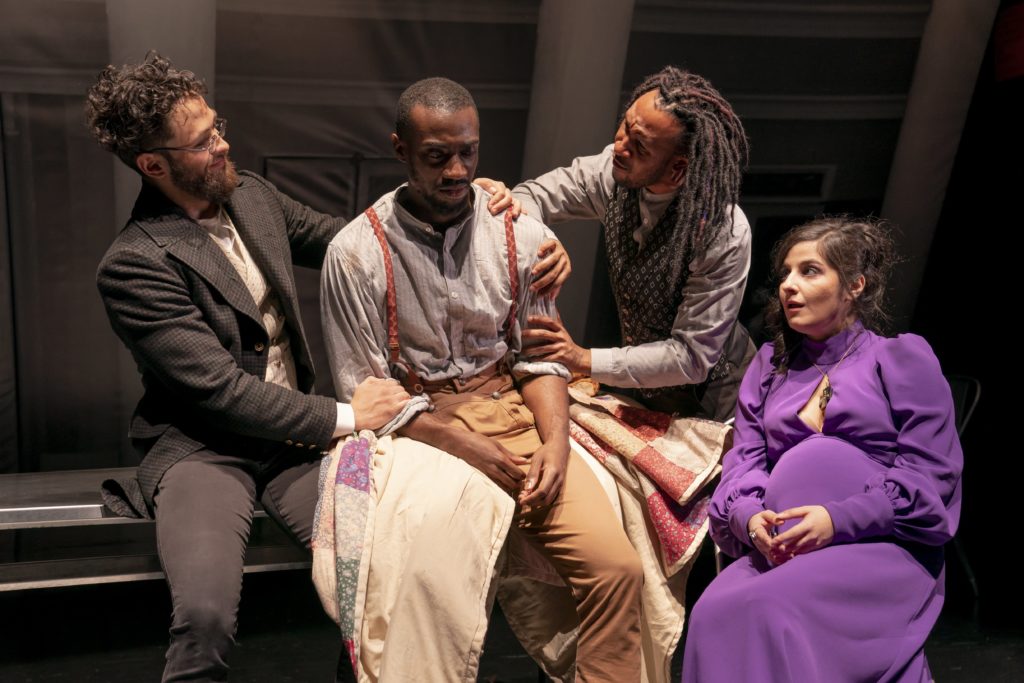 If Bradshaw’s goal in “Southern Promises” was to demonstrate the historical legacy of slavery, Bradshaw skillfully proved that the remnants of slavery are still with us. Consider the white’s description of slaves as childlike, sexually immoral, and intellectually inferior. Black folks are still described as having these character flaws. Bradshaw also brilliantly inserted biblical scripture and references in the script, demonstrating how slave owners used the Bible to justify slavery and their white privilege. Hmm, doesn’t too far removed from what some white supremicists currently do.
Where this production of “Southern Promises” did have some challenges were in the southern, antebellum accents, which unfortunately most of the cast was not able to pull off. And some of the simulated, sexually explicit scenes didn’t really move the story forward and seemed gratuitous in nature.
Standouts in the cast was Brittany Zaken as Elizabeth, mistress of the plantation, who expertly distilled the chilly, cruel nature of plantation mistresses while being aware that their power was limited by their gender. Shakur Tolliver was very good as the docile slave Benjamin. And special acknowledgement goes to Marcus Jones as David, the brother preacher of Elizabeth. Jones really knows how to conjure up the spirit of evangelical, revivalist preachers of that day.

Photos courtesy of Joan Marcus/ Spin Cycle NYC
Though “Southern Promises” is an incendiary drama with racially sensitive language and scenes, Thomas Bradshaw should be congratulated for telling it like it was, causing us to understand that though many things have changed, the memory of and the toxic shrapnel of slavery lives on. Will we ever be delivered from this scourge on our history? Well, only if we tell the truth!! “Southern Promises” runs through April 14 at the Flea Theater. For more information, go to theflea.org.
—William S. Gooch
 When we think of dance, rarely is dance considered a masculine pursuit. Though progress has been made in that respect with great dancers like Rudolf Nureyev, Mikhail Baryshnikov, Gene Kelly, and Gregory Hines, and great hip hop artists, dance is still mostly reserved for women.
 Fashion Reverie: Lets first begin with your first name, Ayodele, what does it mean?
 FR: How did realize you could turn tap dancing into a professional career?
 FR: When people think about tap dancing, they rarely think of women tap dancing and certainly not Latina women tap dancing. What challenges have you experienced around this misperception?
 FR: Could you talk about your best performing experience, and your worst?


 Most ballet stories are quite simple in structure and tone. Complicated story lines don’t often lend themselves well to an art form where movement progresses the story. Consider Sleeping Beauty where a young princess plucks her finger, goes into a deep sleep and awakened by a kiss from a handsome prince. Or Raymonda where a Hungarian princess’ love is coveted by a dark Saracen, who is eventually defeated by the knight Jean de Brienne, leading to a marriage between the Hungarian princess and the heroic knight.


 Are we in a post-racial era? Of course we are not. When Barack Obama was elected as the 44th President of the United States, many hoped and some cultural pundits projected that a post-racial society had arrived.


 We are living in very in challenging times. Times that are dividing us because of disparate political sentiment and life challenges that are causing us to tune out because there are just too many tragedies to digest. Everything seems to be collapsing around us with many of cultural and social institutions failing to give the support and stability we need.


 What is to be said about opera legend Maria Callas that hasn’t always been said? Not much. There have been several documentaries and movies her life—“Callas Forever,” “Maria Callas: La Divina: A Portrait,” Callas Assoluta,” “Maria Callas: Life & Art,” and “Maria Callas: Living and Dying for.” So, is another documentary or movie about La Callas necessary?
 Interestingly, “Maria by Callas: In Her Own Words” is perhaps the most authentic reflection on Callas’ life and there is no doubt that Callas’ life was a life that great dramas are made from. From her up from the almost bottom in the Bronx—most people don’t know that Callas is actually a New York native—to the beginning of her operatic career in Greece to her dramatic weight loss, to her becoming a style icon in the manner of Audrey Hepburn and Sophia Loren to her reputation as a difficult diva, to her affair with Aristotle Onassis everything is documented through interviews and photographs in the diva’s own words.


 Fashion Reverie had the opportunity to sit down with Raheem DeVaughn at the listening party for Raheem’s sixth studio album, “Decade of a Love King.” “Decade of a Love King” was released on October 19 via all streaming platforms.
 Fashion Reverie: When it comes to your top 5 R&B hit “Don’t Come Easy” what’s the inspiration behind the song?
 Fashion Reverie: How would you describe your fashion style?
 Fashion Reverie: Do you have any favorite designers?

 It is not uncommon for an actor to change their appearance for a role. Often this transformation, if the script is good and the film is well directed, can render an Oscar nomination, if not an outright win. Looking back who can forget Charlize Theron’s transformation to the serial killer/man hater Aileen Wournos in “Monster” or Alfred Molina putting on a lot of weight when he played Frida Kahlo;s husband, Diego Rivera, in “Frida?” And what about the late Philip Seymour Hoffman drastic alteration of his body and visage to portray an effete Truman Capote in “Capote.” (In retrospect by Theron and Hoffman won Academy Awards for their characters in “Monster” and “Capote.)
 Though “Happy Prince” is written and directed by Everett, Everett ingeniously mines out a performance that is stocked full of nuance and depth. He even manages to project beyond Wilde’s miserable state of a penniless outcast who depends on the kindness of friends, fellow miscreants with an occasional rent boy thrown in for good measure. In spite of Wilde’s pitiful state, Everett injects a wealth of charm and vibrancy coupled with Wilde’s incomparable wit into his portrayal.
 “The Happy Prince” includes a stellar cast that includes Colin Firth, Tom Wilkinson, Emily Watson, and Edwin Thomas. Still, “The “Happy Prince” is a star vehicle for Rupert Everett. And with his portrayal of a downtrodden Oscar Wilde, we get to see Oscar Wilde in a different light, and how deep Rupert Everett’s well of talent can go. With “The Happy Prince,” Rupert Everett proves he is much more than a pretty face with a British accent. Is there is Oscar nomination in the works? Fashion Reverie thinks so!!


 “Antonio Lopez 1970: Sex, Fashion & Disco” gives a purview into how the worlds of urban street culture, pop music, and the downtown arts scene were beginning to influence the fashion industry. Lopez was at the epicenter of this particular cross-pollination of cultures and infused his art and craft with this mélange of influences.
 Director James Crump carefully examines Lopez’s unique ability to excavate inchoate talent and pushing that talent to the forefront of fashion. Without Lopez there probably would not have been a Grace Jones, Pat Cleveland, Patti D’Arbanville, Corey Tippin or Jerry Hall. And it was Lopez and his partner Juan Ramos that sparked that creative fire and sensibility in Karl Lagerfeld early in his career. Without Lopez and his coterie of creative merry people, perhaps, Lagerfeld would not have developed into the genius who could masterfully combine a variety of influences and popular trends into a seamless expression of beauty and adventure.
 Blending video footage, photographs, Lopez’s fashion illustrations, disco music and some very well-placed interviews from Jessica Lange, Grace Coddington, Bill Cunningham, Pat Cleveland, Joan Juliet Buck, Andre Leon Talley, Corey Tippin, Bob Colacello, and others, James Crump artfully creates the mood and motivation of the late 60s and 70s. This collision of cultures and aesthetics is set against the backdrop of New York City and Paris. In fact, Crump creates such well-collaged kaleidoscope of images, sounds and colors that is almost like being in the New York City and Paris of Antonio Lopez. Still, Crump does not leave out some of the vices that drove Lopez’s creative genius. Though these vices—sex, sex, and more sex—are not the focus of the documentary, Crump does detail Lopez’s excesses without simulating titillating voyeurism.
 “Antonio Lopez 1970: Sex, Fashion & Disco” is currently playing at the IFC Center in New York City through October 4.


