
Image courtesy of Ford Models
Fashion Reverie takes a look back at the life of the legendary Eileen Ford. Considered the grande dame of the modeling industry, Eileen Ford died on Wednesday, July 9.

Ford Models: Images clockwise Brook Shields, Grace Jones, Naomi Campbell, Cheryl Tiegs, Lauren Hutton
Singlehandedly, Eileen Ford changed the modeling world from catch can, badly managed industry to a serious business where models signed million dollar yearly contracts. Ford Models, founded in 1947 by Eileen Ford and her husband managed some of the top models in the industry from Suzy Parker, Jean Shrimpton, Naomi Campell, Grace Jones, Verushka, Cheryl Tiegs, Christie Brinkley, Jerry Hall, and Christy Turlington to model/actresses Jane Fonda, Ali McGraw, Lauren Hutton, Kim Basinger, Brooke Shields, Candace Bergen, and many others.
Starting her agency out of her parent’s home, Eileen Ford, a former model herself, quickly established a five-day workweek for models and helped organize a voucher syste for models, allowing them to be paid in advance of payment to the agency from clients. (Traditionally models waited some times up to a year to be paid from modeling assignments.)
Some of the agency’s early successes were the careers of Dorian Leigh and Carmen Dell’Orefice, with those early models making upward of $3,500 a week. In its 20th anniversary, Ford Models could boast of making $100,000 a week in bookings.

Image courtesy of beautyflashblog.com
During the 1970s and 80s, Eileen Ford had to compete with rival agencies Elite Models and Wilhelmina for top models, prompting Eileen Ford to open offices around the world, expanding her model board to include plus size models, older models, children and artists. In 1980, Ford launched one of the first international modeling competitions, Ford Supermodel of the World.
 Ford Models was sold to investment banking group Stone Tower Equity Partners in 2007. At the time of her death, Eileen Ford was 92.
—William S. Gooch


 Fashion Reverie looks back at the iconic British fashion model/actress Jean Shrimpton. Shrimpton is considered one of the first supermodels and a symbol of Swinging London in the 60s. During her career, Jean Shrimpton was the most photographed and the most highly paid model of the 1960s. Shrimpton’s face graced the covers of Vogue, Elle, Harper’s Bazaar, Glamour, Vanity Fair, Newsweek, Ladies’ Home Journal and Time magazines. She also helped popularize the miniskirt.
 Shrimpton helped usher in a new wave of models that were a direct contrast to the aristocratic models of the 1950s whose look reflected the wealthy women who shopped mostly at couture houses. Closely identified with the Swinging 60s, Shrimpton helped bridge the gap between haute couture and the burgeoning ready-to-wear market. With her doe eyes, arched eyebrows, and long lashes, Shrimpton paved the way for another popular British model of the 60s, Twiggy.
 Jean Shrimpton began a relationship with famed British photographer David Bailey in the early 60s and their four-year relationship was dramatized in the 2012 BBC Four film, We’ll Take Manhattan. Shrimpton also starred in the 1967 film Privilege.
 As Great Britain and the rest of the world anxiously awaits the royal birth of Prince William and Kate Middleton’s child, Fashion Reverie looks back at the career of Marc Bohan, a favorite designer of Princess Margaret. Currently, Kensington Palace is hosting, Fashion Rules, an exhibition celebrating the most stylish outfits worn by the royals throughout the years. The exhibition displays iconic outfits worn by Princess Margaret, the late Diana Princess of Wales and Queen Elizabeth II.
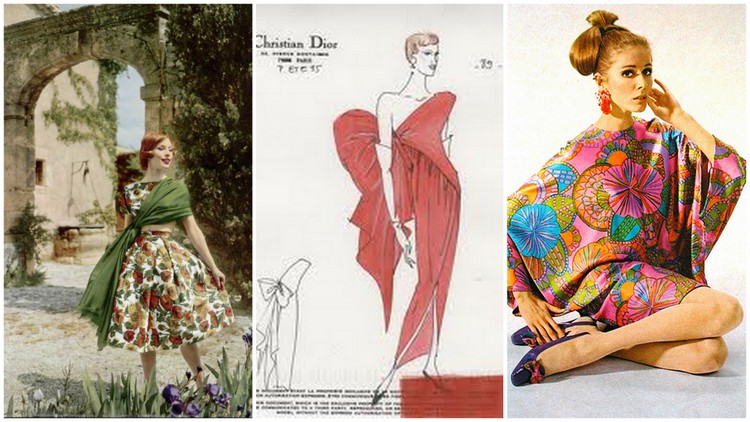 The more conservative Marc Bohan became head designer for Christian Dior after Yves Saint Laurent was called away for military duty in Morocco. For close to thirty years, Bohan maintained the classic look of Dior, borrowing heavily from previous Dior collections and reinvigorating the iconic looks with fresh points of view. During his tenure at Dior, Bohan treated Dior’s signature haute couture aesthetic Bohan’s like luxury ready-to-wear, incorporating influences that were prevalent to changing styles and points of view. Bohan’s lists of celebrity clients while manning the helm at Dior included Princess Margaret, Elizabeth Taylor, Princess Grace, Betsey Bloomingdale, and Sophia Loren.
 Bohan joined the London fashion house of Norman Hartnell in 1989, and since 1992, Bohan has designed collections under his own label.
 Fashion Reverie looks back at French designer Andres Courréges. Courréges with British designer Mary Quant helped usher in the miniskirt. Trained as a civil engineer, Courréges first worked for Jeanne Lafaurie fashion design house and later for the famed couture house of Balenciaga.
 In 1961 Courréges opened his Maison de Couture. Influenced by modernism, technology and non-traditional fabrics, Courréges in the 1960s made his mark in the industry by creating Space Age garments that used plastic and metal. In his 1964 collection, Courréges used a variety of geometric shapes from triangles and squares to trapezoid shapes.
 Always wanting to sell clothing that was affordable, Courréges often attempted to raise funds so that his clothes were more affordable. In recent years, Courréges has extended his brand to include luggage, accessories, and perfume.


