Fashion Flashback: Alek Wek

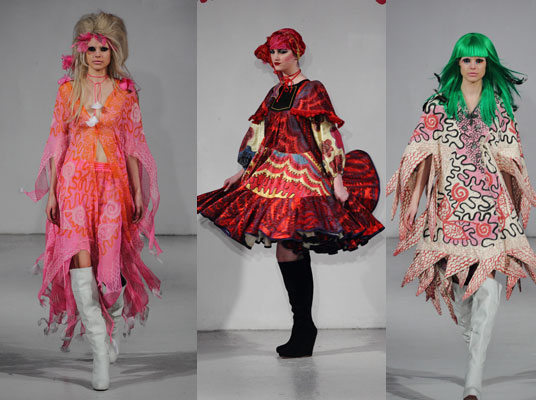
This week Fashion Reverie looks back at the career of supermodel Alek Wek. This month Alek Wek returns to South Sudan for the first time since 2005. During her teen years, Alek Wek and her family fled Wau, Sudan when civil war broke out and sought asylum in London. Wek was later discovered in London by a modeling scout and has gone on to become one of the first African supermodels.

Alek Wek images courtesy of style.com

Alek Wek was the first African model to appear on the cover of Elle in 1997, and was named model of the year by MTV that same year. Alek Wek has walked the runways for John Galliano, Chado Ralph Rucci, Diane Von Furstenberg, Donna Karan, Chanel, Marc Jacobs, Calvin Klein, Jean-Paul Gaultier, Christian Lacroix, Emmano Scervino, and a host of others. She has also appeared in advertising campaigns for Clinique, Victoria’s Secret, Moschino, and Issey Miyake.

Alek Wek is a member of the U.S. Committee for Refugees’ Advisiory, an ambassador for Doctors Without Borders in Sudan, and a missionary for World Vision, an organization that combats the worldwide AIDS pandemic. And in 2007 Wek released her autobiography, Alek: From Sudanese Refugee to International Supermodel, which details her life from poverty in the Sudan to the catwalks of the world.

Images courtesy of style.com

On her return to Sudan, Alek Wek will partner with the UNHCR and plans on taking part in festivities that celebrate Sudan’s one-year independence.  She will also visit her hometown of Wau, capital of Western Bahr-el-Ghazal state.

—Staff

Fashion Flashback: Paco Rabanne’s Metal Mini Dress

Fashion Reverie looks back at Paco Rabanne’s iconic metal mini dress. Francisco Rabeneda Cuervo, commonly known as Paco Rabanne created the chain mail mini dress as a part of his 1967 couture collection.

Paco Rabanne started his fashion career by creating jewelry for Nina Ricci, Pierre Cardin, Courréges, Givenchy, and Balenciaga. He opened his own fashion house in 1966, and he was known for creating fashion forward, sometimes futuristic designs out of such unconventional materials as plastic, metal and paper.

Audrey Hepburn in Paco Rabanne dress in “Two for the Road”

In his first collection entitled “12 Unwearable Dresses in Contemporary Materials,” Rabanne experimented with dresses embellished with rhodoid sequins and plagues. A similar aesthetic popped up in his couture 1967 collection in which Rabanne used metal, aluminum, plastics and other unconventional materials linked together to resemble medieval chain mail. Paco Rabanne created a garment with a similar aesthetic made of acrylic discs threaded together with thin metal chains for Audrey Hepburn in the 1967 film Two for the Road.

Paco Rabanne Metallic Dress, 1996

In 1996 Paco Rabanne revisited the mini dress made of unconventional materials. Paco Rabanne announced his retirement in 1999. And in 2010, Rabanne was made an Officer of the Legion D’Honneur by the French minister of culture.

—Staff


Fashion Flashback: Zandra Rhodes

Fashion Reverie takes a look back at iconic British designer Zandra Rhodes. With her colorful textiles and use of safety pins and seams turned inside out, Zandra Rhodes was one of the new wave of innovative designers in the 1970s that put British fashion on the international fashion scene. With fellow Brit Vivienne Westwood, Rhodes helped usher in the punk aesthetic into British fashion.

Zandra Rhodes has made costumes for Queen’s Freddie Mercury and dressed Princess Diana. In 1997 she was made a Commander of the British Empire and just this February Rhodes held a retrospective of her work during Paris Fashion Week. This was first time Rhodes had shown her designs in Paris since the 70s. The retrospective spanned four decades with garments pulled directly from the Victoria and Albert Museum and the Metropolitan Costume Institute.

—Staff

Fashion Flashback: Elsa Schiaparelli’s Shoe Hat

Fashion Reverie looks back at Elsa Schiaparelli’s iconic shoe hat. Heavily influenced by surrealist Salvador Dali and Alberto Giacometti, the shoe hat was Schiaparelli interpretation of a 1933 photograph of Dali’s wife, Gala, with a slippers on her head. The shoe hat was sketched by Dali for Schiaparelli’s 1937-38 fall/winter collection. Schiaparelli’s shoe hat resembled a woman’s high-heeled shoe with the heel pointing upward. Schiaparelli’s shoe hat was worn by Gala Dala and heiress Daisy Fellowes, the editor of French Harper’s Bazaar.

Variations on Schiaparelli’s shoe hat have popped in the collections of French couturier Eric Tibusch, and recently Lady Gaga donned a stiletto shoe hat.

Fashion Flashback: Vidal Sassoon

Fashion Reverie looks back at iconic hair stylist Vidal Sassoon. Credited for having created the modern, geometric, Bauhaus-inspired style, sometimes known as the “wedge bob,” Sassoon’s style became associated with the mod 60s style and the liberated woman of that time. Vidal Sassoon’s “wash and wear” hairstyles liberated women from having to take weekly trips to salons to have their styles. Grace Coddington, creative director of American Vogue and former Sassoon model says it best, “”he changed the way everyone looked at hair. Before Sassoon, it was all back-combing and lacquer; the whole thing was to make it high and artificial. Suddenly you could put your fingers through your hair! He didn’t create [Sassoon’s five-point cut] for me; he created it on me. It was an extraordinary cut; no one has bettered it since. And it liberated everyone. You could just sort of drip-dry it and shake it.”

Sassoon also developed a line of hair products that racked in at its peak 10s of millions a year. In 1983, when Vidal Sassoon sold his company to Richardson-Vick, Sassoon’s products and salons were grossing $113,000,000 a year.

Vidal Sassoon was made a Commander of the British Empire in 2009. And his biography Vidal: The Autobiography was released in 2010 by Macmillan.

Vidal Sassoon

Vidal Sassoon died at his home in Los Angeles on May 9, 2012.

—Staff

Fashion Flashback: Vidal Sassoon

Fashion Reverie looks back at iconic hair stylist Vidal Sassoon. Credited for having created the modern, geometric, Bauhaus-inspired style, sometimes known as the “wedge bob,” Sassoon’s style became associated with the mod 60s style and the liberated woman of that time. Vidal Sassoon’s “wash and wear” hairstyles liberated women from having to take weekly trips to salons to have their styles. Grace Coddington, creative director of American Vogue and former Sassoon model says it best, “”he changed the way everyone looked at hair. Before Sassoon, it was all back-combing and lacquer; the whole thing was to make it high and artificial. Suddenly you could put your fingers through your hair! He didn’t create [Sassoon’s five-point cut] for me; he created it on me. It was an extraordinary cut; no one has bettered it since. And it liberated everyone. You could just sort of drip-dry it and shake it.”

Sassoon also developed a line of hair products that racked in at its peak 10s of millions a year. In 1983, when Vidal Sassoon sold his company to Richardson-Vick, Sassoon’s products and salons were grossing $113,000,000 a year.

Vidal Sassoon was made a Commander of the British Empire in 2009. And his biography Vidal: The Autobiography was released in 2010 by Macmillan.

Vidal Sassoon died at his home in Los Angeles on May 9, 2012.

—Staff

Fashion Flashback: Lady Christina Duff-Gordon

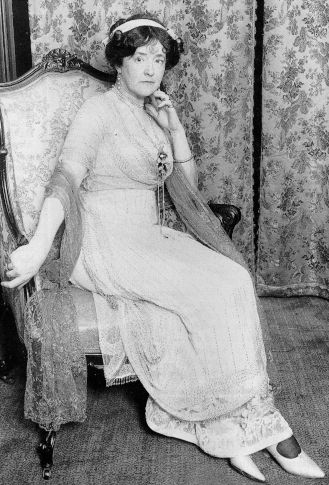
In this centennial year of sinking of the Titanic, Fashion Reverie looks back at one of the survivors of the Titanic, Lady Lucy Christina Duff-Gordon, who was a leading fashion designer of the late 19th and early 20th centuries and is credited for training the first fashion models, as well as staging the first runway or “catwalk” style shows. Professionally known as Lucile, Lady Duff-Gordon, was the first English designer to achieve international success with couture boutiques in London, Paris, NYC, and Chicago. Her clientele included royalty, society wives, nobility, and theatrical stars, including Billie Burke, Irene Castle, and Mary Pickford.

Her company Lucile, Ltd was most famous for designing lingerie, tea gowns, and evening wear. Her design aesthetic was characterized by luxurious draped soft fabric in pastel palettes, often embellished with silk flowers.

A passenger on the RMS Titanic with her husband, Sir Cosmo Duff Gordon, Lady Duff-Gordon was rumored to have told her secretary as they watched from Lifeboat 1 as the Titanic sank, “There is your beautiful nightdress gone.” Such comments fueled charges of negligence as the Duff Gordons were scandalized in the press and tried in court for having paid crewmen not to return to the Titanic for passengers so that Lifeboat 1 would not become overcrowded. Though charges were dropped innuendo and public shame continued until the Duff Gordon’s deaths.

In the past decade, international museum exhibitions, the Metropolitan Museum of Art’s “Cobism and Fashion” (1999), the Museum of the City of New York’s “Fashion on Stage” (1999) and the Victoria and Albert Museum’s “Black in Fashion” (2000), have featured Lady Duff-Gordon’s garments.

Lady Christina Duff-Gordon

Lady Lucy Christiana Duff-Gordon died in 1935 of breast cancer.

—Staff

Fashion Flashback: Donyale Luna

Fashion Reverie takes a look back at Donyale Luna, the first African American cover girl. Born Peggy Ann Freeman, Donyale Luna moved to New York City after being discovered by photographer David McCabe.  At the beginning of her career, Luna was under exclusive contract with famed photographer Richard Avedon. A sketch photo of Donyale Luna appeared on the cover of Harper’s Bazaar in 1965. And in 1966 she was the first African American model to appear on the cover of British Vogue.

At 6`2 with blue contact lenses, Donyale Luna represented the expanding fashion palette for new, interesting faces that reflected the cultural revolution of the 1960s and 70s. Donyale Luna had a burgeoning acting career appearing in several Warhol’s films including Screen Test: Donyale Luna (1964), Camp (1965), and Donyale Luna (1967), as well as Frederico Fellini Satryicon (1970) and Otto Preminger’s comedy Skidoo.

Though Donyale Luna modeling and acting career was marked by erratic behavior and drug abuse, Luna played a significant role in opening the doors for such African American models as Naomi Sims, Pat Cleveland, Bethann Hardison, and many others.

Donyale Luna died in Rome in 1979 of an accidental drug overdose.

—Staff

Fashion Flashback: Thierry Mugler’s Motorcycle Corset

Fashion Reverie looks back at Thierry Mugler’s motorcycle corset/dress which received worldwide recognition after appearing in the George Micheal’s video “Too Funky.” The video directed by Thierry Mugler included models Linda Evangelista, Tyra Banks, Nadja Auermann, Emma Sjöberg, Estelle Hallyday, Shana Zadrick, as well as actresses Julie Newmar and Rossy de Palma. Originally the video was to include supermodels Linda Evangelista, Naomi Campbell, Christy Turlington, Cindy Crawford, and Tatjana Patitz. Later, Mugler decided instead to keep supermodel Linda Evangelista and use new models. The motorcycle corset/dress was a part of Thierry Mugler’s spring/summer 1992 haute couture collection.

In 2010 Thierry Mugler recreated the motorcycle corset dress for superstar pop icon Beyoncé Knowles for her album “I AM … Sascha Fierce.”

—Staff

Fashion Flashback: The 1973 Grande Divertissement à Versailles Fashion Show

Fashion Reverie goes back in the annals of fashion history to the Grande Divertissement à Versailles, the groundbreaking fashion event held in Paris 1973 that changed the way the European fashion world regarded American designers. The brainchild of American fashion publicist Eleanor Lambert, this fundraiser for the restoration of Versailles, was billed by tabloid journalists as a battle of sorts of the old guard (Christian Dior, Yves Saint Laurent, Ungaro, Pierre Cardin, and Hubert de Givenchy) and the new world designers ( Stephen Burrows, Halston, Anne Klein, Bill Blass, and Oscar de la Renta).

Yellow journalistic headlines aside, the American designers were a huge success and helped to introduce the new wave of prêt-a-porter. Also, the Grande Divertissement a Versailles was one of the first times that a group of African American models were seen on a catwalk in Paris. The group included such hallowed names as Pat Cleveland, Norma Jean Darden, Alva Chinn, Bethann Hardison, and Billie Blair. “Part of that excitement came from the African-American community and the music scene, and part of it was a sort of animated desire for a range of looks,” confided Harold Koda, the curator in charge of the Costume Institute of the Metropolitan Museum of Art, to the New York Times.

—Staff

Copyright © 2012-2025 | Fashion Reverie Publications, LLC - All Rights Reserved